|
|
March 11, 2011
The End of The Counterterrorism Blog
By Douglas Farah
To Our Readers:
Thank you for your faithful readership through the past five years. Over its short run, the Counterterrorism Blog served an important role both as a leading terrorism news and information aggregator and as a site where noted practitioner-experts presented commentary and analysis. This combined to make the site a regular “one-stop” bookmark for the interested public, media and policy community at a crucial time. CTB has had a remarkable run, and a tremendous impact – in addition to being visited over 8.2 million times, the CTB spurred news stories, held Congressional briefings, embedded reporters in war zones, and informed the policy debate – even earning a negative review from Al Qaeda!
As the world has changed and the terrorism community has evolved so has the ability of the volunteer contributing experts on the Counterterrorism Blog to dedicate their time and energy to this enterprise. In light of this, the Board has made the decision to discontinue publishing here. In addition to their other policy, professional, publishing, teaching and research responsibilities, many of the CTB’s former contributing experts will be posting on other blogs and can continue to be read.
Thanks again for all the support through the years in making the CTB a leading voice in the Counterterrorism community and for your support and interest.
The Counterterrorism Foundation Board, publishers
March 10, 2011
Modeling Middle East Turmoil
By Aaron Mannes
The other day Slate posted a data visualization to help understand “Which Middle Eastern countries are most susceptible to revolution?”
The visualization was neat, because it cleverly brought in four different factors (unemployment, median age, GDP per capita, and oil exporter or not.) But it also did not provide much of an obvious pattern. Libya had, by far the highest unemployment while Tunisia and Egypt (although this seems low) were more towards the middle of the pack. Tunisia has one of the highest median ages, while Egypt and Libya are again in the middle. As for GDP per capita, Libya is a substantially higher then Egypt and Tunisia (although lower then Bahrain). In short, the graphic does not point to an obvious next domino, although it does indicate that almost everyone in the region is a possible candidate.
But knowing that the nations in the Middle East are ripe for turmoil is hardly news, but the critical questions are when, where, and why. To model that problem requires a lot more variables. In one of my own efforts to model terrorist group behavior I cited Tolstoy who stated: Happy families are all alike; every unhappy family is unhappy in its own way. The same goes for troubles nations (and is there any other kind.) Since I work on this sort of thing for my bread and butter, I thought I’d kick in some thoughts on the kinds of variables needed.
Read the full post here.
March 6, 2011
How to Deal with Islamist Movements in Post-Revolutionary Regimes?
By Matthew Levitt
Initially slow to react to the string of Jasmine revolutions rocking the Middle East and North Africa, the Obama administration is now proactively engaged in policy and analytical reassessments to determine how to respond to various contingencies arising from the new political horizon rising across the region. One such internal assessment, completed in mid-February, focused on differences between various types of Islamist movements that promote Islamic law in government. Such a review is timely, commendable, and appears to be asking some of the right questions. That, however, is no guarantee it will reach the right conclusions.
To be sure, significant ideological differences separate al-Qaeda from the likes of the Muslim Brotherhood, not the least of which is the sharp contrast between al-Qaeda's distaste for national boundaries in it quest for an Islamic Caliphate and the Muslim Brotherhood's ability to mold its Islamist ideology to the specific nationalist contexts of each country in which it is present. And yet, the Brotherhood's Islamist, illiberal ideology includes tenets that raise significant questions about its qualifications as a partner in the democratic process. The threshold for partnership cannot simply be that a group is not quite as extreme or violent as al-Qaeda.
The full article is available here

March 2, 2011
Asserting Liberal Values: The Future of British and U.S. Counterradicalization Strategies
By Matthew Levitt
Radicalization lies at the intersection of grievance and ideology. However, grievances are ever-present and very few individuals choose to act upon them. Ideology, on the other hand, offers a blueprint for action that mobilizes potential terrorists.
A key criticism of the British Prevent strategy has focused on its failure to recognize the importance of ideology in the radicalization process, as evidenced by partnerships with nonviolent Islamist organizations. Though many of these groups reject violence against the UK itself, they are either silent about or even supportive of attacks against Israel or coalition troops in Iraq. Counterradicalization efforts cannot be effective when partnerships are made with those who explicitly reject liberal values. And we must not forget that extremist ideology calling for violence in the name of Islam presents the most pressing terrorist threat to the West. Whether advocated by violent or nonviolent extremists, such radical ideology promotes a worldview at odds with the fundamental principles of Western society and must be contested.
American society has a fundamental discomfort with the government dictating acceptable versus unacceptable ideas. Freedom of speech and religion are arguably the most cherished values in the United States. This position stands in stark contrast with legal and societal norms in the UK or the Netherlands, where distribution of terrorist literature can be investigated and the drafters jailed for creating a threat to national social cohesion. Therefore, in keeping with American values, the United States must develop a strategy that confronts the ideology head-on. While the state cannot act as thought police, it can offer and amplify an abundance of voices, thereby dispelling the notion that Islamist ideology offers the only solution to one's problems and, in effect, limiting its appeal. Without banning extremist (but protected) speech, the government can and must take action to contest extremist ideas and undercut their attraction.
Lacking a version of Britain's Communities and Local Government Department, the United States must immediately develop a roadmap delineating the responsibilities of agencies and departments -- federal, state, and local -- in addressing local grievances, engaging immigrant communities, and contesting extremist ideologies. The last of these items remains the missing link in an otherwise robust effort by the United States to foster social cohesion and counter violent extremism.
For the full summary of this event, which also featured Mark Williams, first secretary for justice and home affairs at the British embassy in Washington, DC., and Mr. Seamus Hughes, a professional staff member on the Senate Homeland Security and Governmental Affairs Committee see here. The audio of the event is available here.
Pakistan and Blasphemy Law: Assassination of Liberal, Secular and Progressive Personalities Continues !
By Animesh Roul
Religious target Killings in Pakistan reached a new low on Wednesday (March 02) when Pakistani federal minister Shahbaz Bhatti was assassinated by pro Taliban elements in the capital city of Islamabad. The slain minister was in charge of minority affairs and a vocal critic of Pakistan's blasphemy law. The only Christian face of present PPP led coalition government Bhatti was known for his views against the blasphemy law.
Soon after the killing, Taliban spokesman Ihsanullah Ihsan said that ‘Assassination of Bhatti is a message to all of those who are against the blasphemy laws." A letter found from the killing site claimed that Taliban killed the minister because he was leading a committee set up with the objective to change the blasphemy law.
On January 4 this year, the Punjab Governor Salman Taseer was killed in Islamabad by one of his guards identified as Malik Mumtaz Qadri, a radical extremist. Qadri confessed during interrogation that he killed the governor for his views against the blasphemy law. The largest body of the Barelvi group, the Jamaate Ahle Sunnat Pakistan (JASP) issued a statement that time saying that “No Muslim should attend the funeral or even try to pray for Salmaan Taseer or even express any kind of regret or sympathy over the incident.”
After Taseer's assassination, Bhatti vowed to fight against the law bringing some necessary amendments. Bhatti once said: "I am ready to sacrifice my life for the principled stand I have taken because the people of Pakistan are being victimized under the pretense of blasphemy law." Bhatti was very active in promoting the equal right of minority communities (Hindus and Christians) in Pakistan. Shahbaz Bhatti was the second high-ranking official killed by Islaimic radicals in the country due to the blasphemy law.
The blasphemy law, which is part of the constitution of Pakistan as the Criminal Code, (See esp. , Part XV: OFFENCES RELATING TO RELIGION) prohibits and punishes blasphemy against Islam and the Holy Prophet Muhammad. The Criminal Code provides penalties for blasphemy ranging from a fine to death.
See the video speech in which he said that Taliban could kill him for his stance on the Blasphemy law.
BBC NEWS: "Pakistan minister Bhatti predicts own assassination"
February 22, 2011
What Cargo May Be Aboard Iranian Warships Transiting the Suez Canal?
By Victor Comras
Iran’s leaders are closely watching the progress of two of their navy warships, the 1500 ton frigate Alvand and the 33,000 ton refueling and supply ship Kharg, through the Suez Canal. They reportedly will arrive at a Syrian port in a few days. The passage of Iranian warships into the Mediterranean is rightfully viewed, in itself, as a provocative act by Israel and by NATO naval forces. Iranian warships haven't been seen in the Mediterranean since the 1970s. But, perhaps, there should also be great concern with the cargoes these warships may be carrying. What a better way could Iran have to circumvent UN and like-minded country sanctions.
UN Security Council Resolution 1749 ( March 2007) prohibits Iran from “supply(ing), sell(ing), or transfer(ing) directly or indirectly ... any arms or related material." All countries are obligated to prohibit the procurement of such items from Iran by their nationals, or to use their flag vessels or aircraft to transport such items. And, these prohibitions are further re-enforced by paragraph 8 of UN Security Council Resolution 1929 (June 2010).
In November 2009, Israeli naval units interdicted the German-owned freighter Francorp in international waters near Cyprus. The ship had called in Iran prior to its transit to the Mediterranean through the Suez Canal. The Israeli navy seized 500 tons of Katyusha rockets, mortars, bullets, and grenades concealed aboard the ship in containers belonging to the Iranian shipping line. The ship’s manifest had indicated a much more benign cargo destined for Syria. This is believed to be only one of many occurences involving illicit shipments of Iranian origin arms in violation of UN sanctions.
Courtesy of WikiLeaks we can now read a series of State Department cables indicating that Sudan was also complicit in allowing Iranian arms to be passed to Hamas in Gaza. In March 2009, Jordan and Egypt were also warned by the State Department of imminent Iranian plans to ship a cargo of "lethal military equipment" to Syria for onward shipment to Hizbollah and Hamas in violation of UN Sanctions.
Canal authorities have indicated that they have obtained assurances from the Iranians that neither Iranian warship carries nuclear or chemical related cargoes, but, no attempt will be made to inspect either ship. And few should doubt that Iran wouldn’t use this opportunity to transport other proscribed cargo such as arms, rockets and other military items. Such items might well be destined for Syria, Hizbollah and Hamas, or elsewhere where it might do harm to US or Israeli interests. And, what cargo might such ships pick up in Syria to bring back to Iran on their return voyage. Iran is known, for example, to be in the market for numerous items to advance their uranium enrichment and ballistic missile development programs. And, Syria is a well known transit point for forwarding sanction contraband items to Iran. It has also served, in the past, as a transhipment point for North Korean contriband items into the region and to Iran.
UN Security Council Resolution 1929 (June 2010) spells out a maritime interdiction system which calls upon all countries to inspect suspect cargoes in their harbor or, with the flag states permission, on the high seas. But, it is highly doubtful that such an interdiction regime could or would be applied to these Iranian warships. This makes it all the more important that the movement of these ships and their presence in Mediterranean ports be closely monitored, and that Syria be held accountable with regard to its international obligations.
February 11, 2011
Egypt and Emerging Trends
By Dennis Lormel
As we witness historic and heroic events unfolding in front of us and marvel about the resolve of Egyptian people tasting true freedom for perhaps the first time, we should start to think about the small group of Egyptians and outsiders who are salivating about the bountiful criminal opportunities that the new found freedom of democracy will present to them. The United States and , in fact, the world is rightfully concerned about what impact Mubarak’s departure will have on peace with Israel, stability in the Middle East, and other geo-political considerations.
In short order, the intelligence and law enforcement community had better assess the emerging criminal and organized crime threat that we will inevitably face. Instead of being reactive, we should be proactive. We need to get out in front and contain the opportunists who will undoubtedly establish the new organized crime apparatus emanating from Egypt. Before they have the opportunity to establish roots, as did Russian and Eastern European Organized Crime, someone should be assessing the scope of the emerging threat. Following that, we better take pre-emptive steps to diminish the new threat before it has the opportunity to overwhelm us. If we can diminish or irradiate this threat before it has a chance to metastasize we won’t have to deal with their costly criminal consequences in a few years.
This, unfortunately, is not likely to happen until we wake up one morning and realize that Egyptian Organized Crime has become a transnational threat. Wouldn’t it be nice to recognize and get in front of such a threat.
February 3, 2011
The Middle East: Democracies or More Terrorism?
By Michael B. Kraft
The demonstrations shaking Arab governments raise questions not only about the political future of Tunisia, Egypt and possibly Jordan and Yemen but also the specter
of increased future terrorism that could trigger U.S. sanctions.
I describe the background and the possible impact on Lebanon, a potential Palestinian state and perhaps other governments, in this opinion piece on CNN’s web site today.
http://www.cnn.com/2011/OPINION/02/03/kraft.palestine.lebanon/index.html
In Lebanon, Hezbollah, designated under U.S. law as a terrorist organization since 1997, apparently is in the process of taking over the government via a Hezbollah-backed Prime Minister. The “state within a state” fired large numbers of rockets against Israel in the 2006 conflict and, with Iran’s help, has built up a huge arsenal of thousands of missiles. Many are long range, capable of reaching Israel’s cities.
The group also has taken Americans hostages in the 1980’sand attacked targets as far as way as Argentina. Will a Hezbollah dominated government continue to engage in terrorist actions as well as giving sanctuary to other terrorists? If so, it runs the risk of being placed on the U.S. government’s terrorism list, which means cutting off foreign assistance and other sanctions.
Egypt has been the victim of terrorist attacks and the Mubarak government has tried, not entirely successfully, to prevent the smuggling of more missiles and weapons to Hamas which took control of Gaza after gun battles against the Palestinian Authority. It remains to be seen what kind of role the Muslim Brotherhood will play and whether the non-violence profile it adopted in recent years was a matter of pragmatism --because of the Mubarak regime’s police and prisons-- or principle.
Jordan, like Egypt has done a good job of keeping the peace and preventing terrorists from using its territory for attacks on Israel. It also has been a target of militant Islamic fundamentalists. King Abdullah is trying to stay ahead of the wave of public unrest by replacing his cabinet. But if he loses control, and Islamic fundamentalist militants take over, that country could join Lebanon and Gaza in becoming a terrorist base. That would be a real tragedy irony as Jordan has taken a strong stance against terrorism and has even been helping train security forces from Iraq.
February 2, 2011
Two Scenarios on Egyptian Succession and One Vision of the Brotherhood
By Jonathan Winer
The similarities between the course of events in Egypt today, and in Iran thirty years ago are obvious: millions of ordinary people take to the street with the sole goal of removing a long-ruling local autocrat who has strong ties to Western powers but is seen as having been deaf the voices of his own people and democracy.
The US then, under Jimmy Carter, as now, under Barack Obama, supports democracy, freedom, and the right of local populations to determine their own destiny.
The autocrat's solid control of the country, backed by the military he commands, rapidly disintegrates. No half measures are accepted -- and suddenly, he is gone.
The question becomes -- what next?
Leaving aside wars for independence from foreign powers, popular revolutions have tended to run in either of two scenarios:
Scenario One: a transitional government proves to be weak, and after a series of violent twists and turns, coups, imprisonments, and executions, a replacement autocrat -- aristocratic, theocratic, or charismatic -- emerges. Come meet the new boss, same as the old boss. Examples include: France 1789 (Napoleon); Haiti 1804 (from Touissant to Aristide, in endless destructive cycle); Mexico 1910 (from Porforio Diaz to 75 years of one-party rule by the PRI); Russia 1917 (Stalin); Germany 1918 to 1933 (Weimer to Hitler); Cuba 1933 (against Machado) and 1956-1959 (Batista to Castro); Ethiopia 1974 (Mengistu); Iran 1979 (Khomeini/Khameini); Russia 1999 (Putin and Putinism); Kyrgyzstan 2005 (Bakiev).
Scenario Two: following mob protests destabilizing the entrenched autocrat, a transitional government steadies the country long enough to allow for a move towards a genuinely democratic government, involving multiple popular interests, without permanent one-party rule by a small insider clique. There are, unfortunately, fewer cases of this, and several of them were in important respects wars for independence from perceived foreign control. Perhaps the best examples include: Turkey 1908 (Young Turk Revolution, which led to Ataturk, but evolved into democracy); Portugal 1974 (the Carnation Revolution, establishing a real democracy); Estonia, Latvia and Lithuania 1979 (the Singing Revolution); Czechoslovakia 1979 (Velvet Revolution); Romania 1979; Indonesia 1998; Georgia 2003 (the Rose Revolution, but the extent to which a democracy has succeeded Shvardnadze is open to debate in light of Saakashvilli's use of the legal system to crack-down on dissent).
There are forces visible in Egypt which provide hope for scenario two, and legitimate anxiety about scenario one.
Read More »
Positive elements include the mix of secular and religious in Egypt, a complex media environment in which no single voice controls, the role of new media in moderating efforts to impose a single vision on society -- a huge development since the Iranian revolution of 1979 -- and a diverse group of commercial interests who may be unwilling to see their property subsumed to someone else's political agenda.
Alternatively, one can look at the risks of two types of autocratic succession. In the first, a familiar one by Middle East standards, a successor military ruler emerges to replace Mubarak. Whatever instabilities may occur along the way, at the end of the day, we have seen that movie before, and it tends to be one in which the ruler's main goal is retaining power, and revolutionary tendencies of all forms are suppressed in the name of real politik. Such a ruler would probably not be very good for the people of Egypt. Corruption, stagnation, and injustice are likely elements of such a regime, but that kind of government in Egypt would at least be familiar to them, and to other governments.
Then there is the example of Shi'ite Iran, and the question of whether the Sunni Muslim Brotherhood might emerge as a ruling political party. Have its leaders evolved from religious revivalists to democratic reformers? Are they interested in gaining power in Egypt only and maintaining a pluralistic society, imposing a theocracy, or do they have the goal of bringing about a more global form of political Islam featuring theocracies everywhere there are Muslims?
One interesting view, is that of Ian Johnson, a Pulitizer Prize winning reporter, formerly with the Wall Street Journal, whose thoroughly researched book on the Brotherhood, "A Mosque in Munich," was published last year.
Johnson visited the Muslim Brotherhood's headquarters in Cairo and described the scene as follows:
"Inside the apartment, the group's militancy is apparent. Pictures of martyred brothers hang on the wall, such as Shiekh Ahmed Yassin, the head of Hamas killed by Israel in 2004. . . The man in charge is the Muslim Brotherhood's 'supreme guide,' Mahdi Akef. . . 'From this small place we run Islam to the world,' Akef says . . . Akef is keen to be accepted by governments and wants the Brotherhood to participate int he political system. He still wants to impose Islamic law, or sharia, in Egypt, but says he would do so slowly, building up support at the grassroots level rather than imposing it from above, as was done in Iran."
Akef retired at age 81 from running the Brotherhood last year, but his attitudes are provocative enough. In 2005, he made statements that supported those of Iran's Mahmoud Amadinejad,writing that he wanted to "expose the false American rule which has become a nightmare of a new world order." In the words of Akef, "He who announces himself party to their alliance is a 'democrat', while he who opposes their methods in the fight against terrorism is a 'terrorist'." He also then used the term "the myth of the Holocaust," as follows:
"Western democracies have criticised all those who adopt a view different from that of the people of Zion about the myth of the Holocaust," said Akef.
While Egyptian, not foreign political institutions will determine what comes in next in Egypt, those on the outside urging the inclusion of the Muslim Brotherhood in succession talks in Egypt may want to keep such statements in mind.
Following years of research that involved interviews with the Brotherhood's leadership in a number of countries, Johnson has reached his own conclusions about the Brotherhood and its larger role internationally., "the Brotherhood nowadays functions as two phenomena: One is narrowly defined as a Egyptian political party. The other -- more relevant in the West in the 21st century -- is an ideological universe [that] could be defined even more broadly as including nearly identical movements around the world," including those in Pakistan and Turkey.
Johnson's conclusion: "Although the Brotherhood says it supports terrorism only in certain cases -- usually against Israel -- it does more than target Jews. It creates a mental preconditioning for terrorism. This mindset divides the world into two camps, those to be protected (a small number of "good Muslims") and the rest (including many other Muslims), who can be destroyed."
If Johnson is correct in his assessment, a theocracy led by the Muslim Brotherhood could be very problematic for Egyptians, and also, it would appear, raise broader problems beyond Egypt's borders. « Close It
January 31, 2011
The Australian Take on the Terrorism Threat
By Michael B. Kraft
The theme that international cooperation is essential to combating international terrorism has been a mainstay of U.S. counterterrorism policy for decades. Usually this means sharing intelligence information, counterterrorism techniques, and sometimes providing training and equipment.
Australia is one of the many countries with which the U.S. enjoys a close relationship.
The Australian Ambassador for counterterrorism, Mr. Bill Paterson, was in Washington recently for meetings with U.S. State Department and other officials, including sessions with experts from other countries.
He also made a public appearance at a Jan 19 round table event of the Homeland Security Policy Institute (HSPI) at George Washington University, which has held sessions with ambassadors from other countries that also are involved in the struggle against terrorism. Ambassador Paterson gave an excellent, comprehensive talk and I just received a copy of Mr. Paterson’s text from the Australian Embassy (delayed because the Ambassador had gone on to Yemen). I thought it worth sharing because of the wide ranging scope of his discussion of the terrorism situation as seen through the perspective of a close ally.
His remarks included a discussion of Afghanistan, saying “We share the view that failing to defend Afghanistan will almost certainly give AQ new momentum and greater freedom of action. It would also strengthen the hand of the Pakistan Taliban and the growing extremist alliance and capability in Pakistan. It would energise anti-western extremists elsewhere, posing a more complex security environment than we already face.
“Hence the commitment of Australia and others to this task… In the end, we are dealing with a globalised extremist movement, and if it is not addressed and neutralised at source, its credibility as well as operational capability will be sustained and potentially enhanced.”
The text of his speech, which also covers Indonesia and his perspective on threats elsewhere in the world, follows.
For further details, also see the HSPI website: http://www.gwumc.edu/hspi/events/australiaART301.cfm
Read More »
Transnational Terrorism: Evolving challenges:
An Australian perspective
By Bill Paterson PSM, Australian Ambassador
for Counter-Terrorism
Islamist terrorism has presented a new challenge to security – it is transnational, religiously-based and draws on a collective sense of both community and grievance across the ummah – the global Muslim community – informed by a deceptively simple narrative. Its Salafist/literalist interpretation of Islam is rooted in the seventh century, but it is empowered by 21st century globalisation and modern technology.
The issue has particular complexity because a political ideology has been built from an absolutist interpretation of a religious faith. Hence opposition to the violent ideology can be painted by its followers as being anti-Islamic.
Islamist terrorism is not a purely Arab phenomenon although key ideologues and movements came from the Arab world – and extremists elsewhere look back to the Arab world as a source of religious legitimacy and historical association.
Terrorism as an Australian national security issue
110 Australians have lost their lives in nine major terrorist attacks from 9/11 on. Many more have suffered injury and loss. The Australian Embassy in Jakarta was badly damaged in an attack in 2004, and a number of planned attacks in Australia have been disrupted over the last decade.
Australia has also specifically and repeatedly been listed as a legitimate target in AQ and JI propaganda, and been linked with the US and UK, in particular, as force contributors in Afghanistan and Iraq.
It is our judgment that AQ-led, associated or inspired transnational terrorism will remain an enduring and evolving security threat internationally – and Australia will remain a target
Terrorism affects Australian interests and those of our allies and friends, but it does not represent an existential threat or a territorial threat to Australia or Australian interests. Hence it is best considered as one of a number of enduring security challenges or contingencies with which we must deal and for which we must plan. It must also be dealt with as a potent form of criminality and not dignified by religious purpose.
While it should be set in context, transnational terrorism can have a disproportionate impact and present unique challenges for the security policymaker: it is both global and local, it is evolving and adapting, developing in terms of its use of technology, its operational security, its complexity, the nationalities involved, and its geographic nodes
- it creates pressures for tougher countermeasures which can impact on rights, freedoms, convenience and costs
- it is thus a more diffuse, dispersed and complex target than it may at first have seemed, and as such has become, as the Australian government’s 2010 White Paper on Terrorism said, ‘a persistent and permanent feature of Australia’s security environment’
- it is also still close to the top of foreign policy priorities identified by Australians in the recent annual Lowy Institute poll of public opinion toward foreign policy issues, ranking only behind protecting the jobs of Australian workers and strengthening the economy.
Where are we at?
We share the view that failing to defend Afghanistan will almost certainly give AQ new momentum and greater freedom of action. It would also strengthen the hand of the Pakistan Taliban and the growing extremist alliance and capability in Pakistan. It would energise anti-western extremists elsewhere, posing a more complex security environment than we already face.
Hence the commitment of Australia and others to this task. We know from experience that this has directly impacted on Australians and Australian interests. In the end, we are dealing with a globalised extremist movement, and if it is not addressed and neutralised at source, its credibility as well as operational capability will be sustained and potentially enhanced.
So where are we at in addressing the terrorist challenge?
Positives and progress
The failure of the transnational aspiration (caliphate)
- The Muslim masses – the ummah - have not been mobilised by AQ’s narrative – increasing awareness that terrorists kill mostly innocent Muslims and are most active in Muslim majority countries
- For instance, in 2009 in Pakistan, 87 suicide bombers killed 1300 people, 90 per cent of whom were civilians
- AQ’s narrative justifying violence and targeting the West and ‘apostate’ Muslim governments has failed to resonate widely
- but extremists still play with some effect to perception that Muslim lands have been occupied and injustices done
- rallying a sense of Muslim group identity and grievance.
Steady elimination of AQ senior leadership
- AQ’s sanctuary in Pakistan’s Khyber Pakhtunkhwa is being squeezed and the core leadership steadily eliminated; AQ’s core leadership is effectively no longer in Afghanistan – only small numbers of lower-level AQ fighters remain in Afghanistan
- AQ’s leadership is preoccupied with survival (and propaganda) – it’s outlook is bleak, but not yet terminal
- The AQ leadership is no longer a ‘doer’ but more a commentator – its operational relevance and its C2 have been diminished
- this has implications for the brand’s stature, unity and appeal, and its ability to recruit and attract finance
- nevertheless, AQ has been durable and its capacity to regenerate, should conditions permit it to do so, should not be underestimated
- It’s been around 20+ years, and the idea will likely outlast the leadership.
The decline of AQ in Iraq (AQI)
- the invasion/occupation of Iraq and a relate sense of Sunni disenfranchisement acted as catalysts for the rapid development of AQI
- but Iraqi tribes’ interests were in the end essentially local and they did not embrace the AQ global narrative
- AQI’s sectarianism and extreme violence alienated most Iraqis
- And as the foreign fighter flow into Iraq was stemmed, AQI lost a catalyzing and regenerating force
- AQI is still deadly, but it’s been heavily attrited and key senior leaders killed
- AQI is essentially domestically-focused (and anti-Shia) but it could rebuild as a focus of sectarian violence if Iraqi political systems fail.
Dismemberment of JI and (some of) its splinters in Indonesia
- Southeast Asia’s success story (in world’s largest Muslim country)
- Nearly six hundred terrorists arrested and around 470 jailed, with over 50 currently on trial
- important because JI had links to AQ and shared its ideology and aspirations
- 17 July 2009 Jakarta hotel attacks served as a wake-up call (there had been no major attacks since 2005), demonstrating the potency, durability and organisational skill of splinter groups which survived the pressure which had been placed on JI by Indonesian police
- But 17 July was followed by an impressive and effective Indonesian-led response, with the elimination of key operatives Noordin Top and, later, Dulmatin, following exposure a year ago of a major new terrorist training camp in Aceh
- More recently, JI’s emir, Abu Bakar Ba’asyir, has been re-arrested and faces trial on incitement to terrorism charges
- But again, a qualification: the Aceh camp is indicative of the enduring nature of the extremist fringe in Indonesia. I’ll come back to that.
Pre-emption/prevention of key plots
Many plots have been pre-empted including over the last year, particularly in western countries
- through increasingly smart intelligence and investigation
- and enhanced protective security measures which act as a deterrent – although they may have the effect over time of transferring risk to softer targets.
- but the Detroit Northwest airlines plot on 25 December 2009, in particular, pointed to gaps in information sharing and the translation of intelligence into pre-emptive action
- this was not only a US problem, leading to remedial steps subsequently being implemented in many countries
- hopefully this will ensure our ability to detect and intervene before the commission of terrorist acts continues to improve
- but there is a common expression in the CT world that the terrorist has to succeed only once, whereas we have to do so every time.
-
Improved counter-terrorism capability in many partner countries
The development of intelligence, law enforcement, forensics and biometrics, financial tracking, aviation security, protection of critical infrastructure, the accounting for and management of explosives, chemical, biological agents and radioactive materials has strengthened capability in many countries. Many obvious vulnerabilities have been addressed, at least in part
-but gaps remain and international practice is highly variable: the air cargo logistics chain is a current example.
You will have noted that all the indicators of progress I’ve listed are qualified: we are dealing with a complex set of issues and it is not possible to declare that any part of this problem has been solved or eliminated. Indeed, we face significant challenges ahead.
Challenges
At 9/11 we had one apparent adversary: we now face a more diffused and diverse threat with affiliates, franchises, fellow travelers and self-radicalised individuals dispersed over a wide geographic area – harder to detect and hence harder to pre-empt.
A new paradigm? Attacks may increasingly be small-scale, opportunistic, with little preparation, training or lead-times. Failed attacks may be considered successful due to their disruptive effects, demonstration of vulnerability and generation of fear and uncertainty. Attackers are probing potential points of vulnerability.
So the spectrum of possible modes and scale of attack has widened – from extensively planned mass casualty attacks (harder now to undertake as more likely to be detected) to ‘micro-terrorism’ - simple local actions on the part of individuals radicalised, for instance, over the internet. In short, the threshold of attack has been lowered.
We are seeing adaptation, decentralisation and proliferation in the terrorist threat, as well as a stronger effort to reach into western societies using insiders.
The threat can often be linked to failing or deeply troubled states, to separatist insurgencies and sometimes to state actors – but the new paradigm for the West is that it can also arise internally in developed and democratic societies.
In addition, a process of political transition may be underway in parts of the Arab world, as we’ve just seen in Tunisia, which could in some cases prove disruptive and offer opportunities for extremist groups (but not, it seems in Tunisia) to tap discontent and build support.
So terrorism will be with us for a generation, or perhaps longer. And there may be no point at which victory can be declared.
AFPAK still remains central
The Afghan-Pakistan border still remains the destination of choice for extremists from elsewhere to link up and to train
- The UK claims more than 70 per cent of the terrorist cases it has under investigation have links to Pakistan. A similar pattern may be emerging in the US and elsewhere
- Pakistan, though, goes beyond simply an AQ problem: the Pashtun Taliban and government-created or facilitated groups such as Lashkar e Tayyiba now have a life of their own
- Pakistan presents a very diverse spectrum of militant Islamist organisations: in some cases groups created by or tolerated by the Pakistan military as assets against its adversary India, have built the ability to mount structured assaults both in and beyond Pakistan, and may no longer fully under government control
- they potentially represent a threat to the stability and effectiveness of elected government in Pakistan
- and also have the potential to precipitate a new, complicating and dangerous crisis with India
- in turn, this could in extremis raise concerns about the security of Pakistan’s nuclear weapons (terrorist groups are interested in acquiring WMD).
Indonesia
Despite Indonesia’s CT successes, it presents a diffuse and persistent extremist landscape, hardly surprising in a large and diverse democracy
- and one with a background of communal conflicts and durable, if small, extremist strains within Indonesian Islam
- the discovery and disruption of a major extremist network in Aceh in February 2010 arguably illustrates Indonesian CT success, but also the durability and evolution of the challenge
- the Aceh coalition of extremists was surprisingly large (over 100 arrested), committed, experienced and aimed at developing an AQ affiliate in Indonesia
- it was ambitious, experienced and was planning a Mumbai-style armed assault, including a plan to kill the President
- around twenty recidivists, previously convicted on terrorist offences, were involved
- Aceh demonstrates that extremist capability may have been reduced but has not been eliminated. The risk of regeneration remains – and key individuals are still at large.
(1) Geographic spread
The European dimension – ‘home grown’ terrorism in immigrant communities – is of perhaps growing scale and concern
- British Pakistanis are perhaps the UK’s sharpest domestic security threat (1760 terrorist-related arrests in UK since 911- 200 of which last year)
- this problem involves complex issues of identity – or multiple identities – and issue of sharing of values, particularly evident in Muslim communities
- socio-economic deprivation, community isolation and consequent youth alienation are likely contributing factors to extremism.
Pakistani extremist groups have reach into expatriate communities in host countries
- Particularly Lashkar e Tayyiba, which has international capability and is no longer fully under Pakistani government control
-
Hizb ut Tahrir, despite eschewing violence, promotes extreme views and is highly organised internationally.
There is also spreading extremist violence in North Africa and south into Sahel (AQIM)
- with the potential to play back into France, Denmark, Netherlands Belgium and the UK.
Somalia is increasingly being drawn into the AQ franchise network, with growing numbers of foreign fighters involved
- And some émigré Somalis returning to join jihad
- The 2010 attack in Uganda at the time of the World Cup, and previous attacks in Kenya, demonstrate the reach of Somali or related groups into East Africa.
Yemen has effectively become a new safe haven, with a distracted government fighting two rebellions internally. AQ-linked terrorists in AQAP pose a particular threat to Saudi Arabia as well as to targets in Yemen itself
- there are, notably, Yemeni links to international terrorism from UBL to ABB
- Yemen is increasingly serving as a magnet or hub for extremists elsewhere – including non-Arab ‘cleanskins’ - to congregate, plan and train, in much the same way Afghanistan was used during the 1990s.
Lebanon remains a hotbed and crossroads for extremist activity – both Sunni and Shia. Sunni sectarianism and militancy is growing, including in Palestinian refugee camps.
Local Muslim separatist insurgencies in southern Thailand and the southern Philippines (Mindanao) are long-standing, intractable and violent, arguably marked by a lack of resolve in both countries seriously to pursue early resolution. These insurgencies are less about the global jihad and more about issues of recognition of identity and economic equality. But frustration could lead to building or restoring international links and a more jihadist cast to essentially parochial claims.
AQ influences also play out in Australia in local plots – domestic terrorist cases have had Mid East (particularly Lebanese), South Asian and North African (Somali) links. AQ is a global brand and it has had a following in Australia.
Spread and durability of AQ ideology and the franchise
- Will setbacks undermine AQ’s attraction?
- Continuing catalysing power of the Israel/Palestine issue and western presence in Muslim lands
- on issues important to Muslims, the West is seen to be on the wrong side of the divide, often supporting apostate or autocratic governments
- campus radicalisation by fundamentalist/Salafist groups (eg Hizb ut Tahrir) is in some countries energising Muslim students around these issues
- the ‘transmission belts’ of internet, contact via the hajj and umrah pilgrimages, unregulated madrassah education, migrant workers and student flows
- and the global power of Al Jazeera (Arabic) and other services to convey a grim pictorial reality to the ummah, a point made to us by French professor Bernard Rougier
- And, adaptability and resilience of terrorists – they are learning organisations often led by university-educated ideologues.
(2) Radicalising power and operational value of the internet
- In some contexts, internet may be more important than the imam or the madrassah
- And key to the development of a new generation of ‘self- radicalised’ extremists, dispersed, unaffiliated and largely invisible to intelligence or law enforcement agencies
- Proliferation of jihadist websites – they number in the thousands - and difficulties/issues in disruption or manipulation, particularly in liberal societies
- The technology is accessible, low cost, immediate, portable, unregulated, global
- The internet is a propaganda and recruitment tool, source of data and knowledge transfer, fundraiser / medium of funds transfer, and is used for operational planning
- Opportunities for social networking via You Tube, Face Book, Twitter provide additional opportunities for terrorist communication
The internet may be making English the second language of jihad, widening the audience for the AQ narrative.
Growing lethality
911was a paradigm shift in terrorism (transnational, franchised, mass casualty, IT-empowered)
- The future?: mass casualty/CBRN - or structured armed assaults (fedayeen attacks), suicides and IEDs, or ‘loners’?
- CBRN can be hard (least likely but biggest impact), but the others have proven effective (low cost, high impact) and are growing in sophistication
- with cheap off-the shelf technology an enabler (Mumbai: GPS, Google Earth, VOIP, Twitter, mobile phones, commercially-available encryption, remote control units, digital watches as triggers etc)
- aviation (and mass transport) will remain an attractive target
- physical attacks rather than cyber, for instance, will be preferred to inflict casualties and get media attention
- And devices concealed in body cavities represent a further evolution and a new challenge to detection.
Prisoner radicalisation
Increasing evidence of radical Islamist ideas being spread in prisons by convicted terrorists
- while many detained or convicted terrorists are now completing terms in detention and re-entering civilian life
- patchy efforts at de-radicalisation or disengagement programs have so far produced mixed results
Disrupting terrorist financing
Terrorist attacks often cost relatively little
- But groups need money for travel and to support the families of martyrs
Informal channels (eg hawala) and cash couriers are difficult to stop
- Porous borders, expatriate labour, connections to other criminal activity and to smuggling present major law enforcement challenges.
Impact of the global economic crisis (GEC) and continuing economic volatility
- If AQ is largely neutralised, will the US and others – faced with difficult budgetary environments, expensive commitments and competing pressures - lose interest and reduce involvement?
- budgetary pressures will limit resources, public opinion is negative about extended military involvement, and an absence of attacks within the US could lead to – or demand - some re-ordering of priorities
- in the US and elsewhere, including Australia, pressure is on police and intelligence agencies to shave budgets and personnel, and for police to restore focus on other forms of crime
What policy responses have worked and not worked?
Intelligence capabilities have been greatly enhanced in size and reach since 911 – have significantly enhanced pre-emption and prevention. Counter-Terrorism is an intelligence-led discipline, but its reach remains limited, by legal limitations, by technology and geography, and by the scarcity of humint.
Effective criminal investigation, prosecution and conviction in Indonesia, Australia, UK and elsewhere have been important in building public understanding and support for robust government action.
The Australian Federal Police model in SEA
- Building long-term law enforcement relationships, building police capabilities (and stature) – often poorly equipped and trained by comparison with military counterparts
- Catalysing inter-agency and cross-border contact , undermining silos and mistrust
- The JCLEC model – Indonesian law enforcement training institution.
New technologies
Decapitation approach via Predator UAVs has had a significant effect– illustrative of the effective use of new technologies. Others, fusing biometrics, forensics, the exploitation of mobile phone tracking and computer hard drives with more conventional humint are potential ‘game changers’ (as important, some in the US believe, as sigint was in World War II)
Physical security measures
Physical security measures and measures to protect critical infrastructure and the integrity of identity have undoubtedly reduced points of vulnerability and acted as a deterrent.
Counter-radicalisation(CR)
A developing discipline of as yet uncertain impact
- CT capabilities have significantly improved, but attenuation of what appear to be contributing social conditions in vulnerable communities –marginalisation, alienation, poverty, unemployment, lack of access to modern education – has a long way to go:
- Radicalisation ‘hotspots’ notably coincide with poor socio-economic indicators
- Deprivation cannot justify terrorism, but it fosters grievance and recruitment and plays to the AQ narrative
- CT policies need to blend tough law enforcement or military action with other instruments of state power such as development aid, law enforcement and access to justice and to social support mechanisms,
- Addressing the drivers of radicalisation and sources of facilitation
- Australia has focused CR efforts internationally on assisting community groups in building community resilience, conflict resolution, and promoting inter-faith dialogue.
- Our approach is to work with credible local leaders to support them in finding local solutions to local problems
- Programs of school-building and basic education have a secondary counter-radicalisation dimension, offering skills which enhance employment opportunities and connections with the community.
- Prison reform/prisoner rehabilitation is potentially an area where significant gains might be made. Like education, its impact would extend beyond counter-radicalisation and represent progress more broadly in development and governance.
De-radicalisation/disengagement programs for convicted terrorists
- An uncertain science, but a developing one
- Recidivism is evident, but effort may assist in limiting spread of extremism through detention, and re-integration after release
Counter-messaging and encouraging moderate Muslim voices
Has had limited success, particularly where the hand of Western agencies is evident
- Frustration and exhaustion with violence in Muslim communities may be encouraging local leaders more robustly to challenge the terrorist narrative
- But encouraging a view of Islam as a dynamic faith rather than a static one rooted in the seventh century must in the end be a job for progressives and moderates in the Muslim world
- It cannot be a job for western governments.
« Close It
January 29, 2011
Terror and Politics: Lashkar-e-Taiba, HuJI and Assassinations in Bangladesh
By Animesh Roul
Very often western observers play down the existence and influence of Pakistan based Lashkar- e-Taiba and Harkat-ul-Jihad Islami inside Bangladesh’s territory. Investigations into number of terror strikes in Bangladesh occurred between May 2004 and December 2005 have revealed, rather unearthed, a lethal nexus between these two Pakistan based terror groups and couple of mainstream political parties in Bangladesh. It also revealed how they teamed up to score a political point by assassinating rival political leaders.
The LeT had sent a cache of ‘Arges’ grenades to HuJI’s Bangladesh franchise which were used in at least seven major terror attacks, six of them targeting then opposition Awami League leaders including AL leader and present Prime Minster Sheikh Hasina, British High Commissioner in Dhaka Anwar Choudhury and Awami League legislator and a former finance minster Shah AMS Kibria. These deadly Austrian manufactured Arges grenades (allegedly counterfeited by Pakistan military/ISI) have been used by Pakistan based terrorists and more recently used in Mumbai 2008 attacks.
List of High Profile Assassination attempts with Arges Grenade:
May 21, 2004: British High Commissioner to Bangladesh Anwar Choudhury was wounded in a grenade attack. While Anwar miraculously escaped the attack with minor injuries, at least three people got killed in that attack and 70 others injured. The attempted assassination by HuJI terrorists came when Anwar was visiting the Shrine of Shah Jalal in Sylhet.
June 21, 2004: Similar grenade attacks took place at a rally of AL leader Suranjit Sengupta in Sunamganj (at Derai subdivision). One AL activist was killed and nearly 30 people were injured in that attack. Suranjit Sengupta escaped unhurt.
August 07, 2004: HuJI terrorists lobbed a grenade targeting an Awami League gathering that left one AL leader (AL publicity secretary Mohammad Ibrahim) killed and 25 others seriously injured. The attack took place moments after the City Mayor and AL’s Sylhet chief Badaruddin Ahmed Kamran left the venue after the meeting.
August 21, 2004: In an attempt to assassinate Sheikh Hasina, terrorists lobbed a series of grenades targeting Awami League (AL) leader Sheikh Hasina’s rally on Bangabandhu Avenue in Dhaka. Attacks left at least 24 people killed and hundreds including senior AL leaders Abdur Razzak, Amir Hossain Amu, Suranjit Sengupta, and Kazi Zafarullah critically injured. A lesser known Islamist outfit Hikmat-ul-Zihad claimed responsibility for the grenade attacks in Dhaka. A person named Hider Rob had e-mailed a message to a vernacular daily Prothom Alo issuing a threat to kill Sheikh Hasina. The message reads like this: “Don’t think that Sheikh Hasina is out of danger. We missed our previous chance but now we are very careful for our mission. Tell her to be prepared. We are coming and this time we will accomplish our target within seven days.”
January 27, 2005: AL leader and former finance minister, Shah AMS Kibria, and four other AL members were killed and at least 50 persons sustained injuries during a grenade attack on an AL rally at Boidder Bazaar in the Habiganj district, some 120 kilometers northeast of the capital Dhaka.
December 02, 2005: Sylhet city Mayor Badruddin Ahmed Kamran escaped similar grenade attack (a dud one) again during a local Badminton Competition at Tilagarh area of the city.
Investigating agencies in Bangladesh claimed that at least 32 Arges grenades sent by Lashkar e Taiba to Huji-B operatives and those were used in at least seven major terror attacks during that period: Six of them targeted AL leaders and the other was on Anwar Choudhury. Huji along with its political patrons aimed to eliminate AL leaders considered Anti Islam and Pro-India and used these imported Grenades with great effect.
Subsequent investigations into these terror acts unearthed how this cache of Grenades shipped into Bangladesh from Pakistan. Many of the accused including HuJi chief Mufti Abdul Hannan, are behind bars now. Now Bangladeshi agencies are probing to find out the extent of LeT and HuJi links that plagued the region.
Read More »
[Crossposted at the ASI Blog] « Close It
January 28, 2011
Ozymandias in Egypt
By Jonathan Winer
Even as Egyptian President Hosni Mubarak orders his government to resign, well-informed experts are concluding that the course of events in Egypt is not likely to result in a revolution. They argue that Egypt's military controls the country and understands that a revolution generally isn't good for business.
In the words of Brookings Institution expert Ken Pollack, "The history of revolutions is that they only succeed when the government loses the will or the capability to use violence and so far there is nothing that is happening in Egypt that suggests that either one is going to happen."
From this perspective, it doesn't matter that Egypt's government, like that of Iran under the Shah, faces resurgent Islamic fundamentalism attacking a government seen as corrupt and overly close to heretic governments in the west. It's insufficient that the government is unpopular, perpetuating and exploiting gross income inequality, and for ordinary Egyptians, fundamentally unjust. So long as the local military doesn't lose its will to retain power, the center will hold.
By this calculus, the Iranian Revolution was only possible because the Shah left town on January 16, 1979 after being unwilling to be sufficiently ruthless in using his secret police, the SAVAK, to crack enough heads.
Read More »
The State Department is telegraphing in every statement its view that such hope as Hosni Mubarak has for maintaining control will come through finding mechanisms, even at this late date, for reform, rather than through a military lock-down. Rather than being naive, this is probably the best hope that Egypt has.
Other revolutions suggest that there comes a time when repression, rather than suppressing revolution, fans it. Certainly, the Czar's regime did not become less repressive under Nicholas II than it had been under his father. Instead, the Czar became blamed after soldiers fired on unarmed protestors in 1905. While it took the regime another 12 years to fall, when it did, those participating in the revolution included ordinary sailors and soldiers who had simply had enough of life under the Czar. Their actions were in turn fanned, shaped, and ultimately taken over, by the ideologically clear Bolsheviks.
A similar process took place in the Iranian revolution. In December 1978, some 17 million people marched peacefully to demand that the Shah resign and the Ayatollah Khomeini return from his exile in France. Their actions were shaped by the fundamentalists, and stimulated by them, but not yet controlled by them. One month later, the Shah left and the Ayatollah returned. One month after that, the Ayatollah called for the Shah's arrest and trial, and a process of systematic radicalization controlled by the religious (and political) fundamentalists began that has culminated in the discrete charm of Ahmadinejad's unique brand of populist theocratic authoritarianism. The similarities between the course of the Russian and the Iranian revolutions, separated by more than six decades, and powered by vastly different ideologies, remain profound.
It's hard to see a tipping point until after the weight has shifted.
In Eastern Europe, the rainbow colored revolutions generally did succeed after Soviet governments lost the will to fight. Militaries did not play profound roles in those revolutions -- Germany, Poland, Romania, even Russia -- once the political will at the top to oppose the change had been lost.
Even the relatively bloody revolution last spring in Kygryzstan predominently involved political changes, initiated by elites but assisted by broad popular support, rather than by determination of who would be in charge by the military.
Tunisia's revolution, too, was driven by a popular movement, without the military playing a fundamental role pro- or con-. Just 21 people died in the Jasmine Revolution, suggesting that the military ultimately chose not to weigh in as it might have as Ben Ali's government's fate was determined by the broader Tunisian public.
Can a gigantic, well-funded miitary with an almost complete monopoly of force in a country overpower a popular revolution demanding change? Perhaps. Certainly, the Islamic government in Iran continues to demonstrate its power and authority, showing its utter willingness to kill street protestors after the disputed 2009 elections.
But that government retains true believers. How many true believers remain in Iran may be subject to dispute -- but is there still some popular support for Amadinejad and his government? By all appearances -- yes.
Mubarak's government, by contrast, is a government of the army, not a government backed by any ideology. Pharaohs and Caesars, look indomitable, with the frown, the wrinked lip, and the sneer of cold command, until suddenly, one day, they don't.
Revolutions bring huge risks, as short-term instabilities can evolve into deeply anti-democratic, corrupt, and dangerous regimes. A transition in Egypt that avoids a fundamentalist takeover while providing the development of a more just civil, political, and economic order, would be very good news indeed.
The State Department is right to hope that it will go that way. But Egyptians, not outsiders, will determine the course of the next stage of their history from here.
« Close It
Institutional Weakness & Egypt's Future
By Aaron Mannes
Events in Egypt are developing quickly. Predictions are a dangerous business, but even if the Mubarak regime can ride out these protests, something profound has changed. In a region where l’etat c’est moi is the standard for the rulers, ripping down the giant posters of President Mubarak is a profound symbol of the public’s disaffection.
Facts about economic stagnation and reports of human rights abuses can tell the story of Egypt’s decay under Mubarak – but perhaps this newsbrief best encapsulates the situation: Egyptian security forces detained a schoolboy for several hours after he wrote in an exam that President Hosni Mubarak was a tyrant who ruled over cowards, an Education Ministry official said on Monday. Safwat Hassan, 17, wrote in his end of high school exam in the southern city of Luxor that Mubarak was "a tyrannical leader" and Egyptians were "a cowardly people," the official in Luxor told AFP. The official said the boy wrote the answer in a maths exam because he was convinced that he was going to fail as he comes from a poor family that could not afford treating school staff to the customary meals during exam time. Egyptian teachers are notoriously badly paid and almost always have to take on private classes and accept gifts to make ends meet. Hassan was questioned for several hours by local security forces and "might be charged with defamation," the official said, without being able to say how security services found out about the boy's answer. The teenager has been barred from taking more exams this year and will have to retake them all next year, the official said. I think this story speaks for itself, shedding light on the Egyptian government’s ability to provide services, the pervasive police state, and the economic prospects for most Egyptians. This revolt was long in coming. The United States should have been pressing for reform in Egypt for decades (as I discuss here in this article discussing the ideas of Egyptian liberal writer Tarek Heggy.) But, in fairness to policy-makers and implementers pressing for reform in other countries is not so easy to do (as I learned while researching the Gore-Chernomyrdin Commission.)
Predictions in a situation like this are impossible – but a few observations are in order.
First, there have been innumerable calls for the United States to support the protesters and align its policy with democracy in Egypt. This is probably the least bad course of action. But there should be no illusions on several points. For the vast majority of Egyptians, the United States is inextricably linked to the hated regime. Nothing the White House or Foggy Bottom does can change that in a few days, weeks or months. Also, the ability of the U.S. to influence events is limited. It does appear that Secretary of State Clinton’s call for the Egyptian government to not respond with violence did send a message to Egypt’s generals that the U.S. would not support a violent crackdown. (A not dissimilar message was sent to Iran’s generals as the Shah’s regime was falling.)
Second, it has been observed many times that the protests are secular and the Muslim Brotherhood is not the driver. This is probably true. But there are no institutional mechanisms for a power transfer. If the regime falls, there is no opposition in the wings to take power. Effective institutions and political parties are essential for democracies to function. One of the major failings of the post-war planning for Iraq was that Iraqi institutions were reasonably functional and that there would not be a massive governance vacuum. In that chaos, the Muslim Brotherhood might prove to be the best-organized player and be well positioned to take charge.
Read the complete entry here.
January 25, 2011
Moscow Airport Attack: Suicide bombers in spotlight again
By Michael B. Kraft
The terrible suicide bombing of a Moscow Airport Monday that killed 35 persons and wounded more than 130, prompted the following analysis of the tactic by Joshua Sinai, a veteran counterterrorism analyst now at Virginia Tech University..
In an opinion piece that appeared on the CNN web site today, Professor Sinai, an old friend and colleague, wrote in part:
"Most suicide attacks are commissioned by organized groups directly or by "self-starter" cells, such as London's 7/7 bombers. This is one of the reasons why the Moscow bomber was likely aided by accomplices.
"It is easier for groups to transform susceptible individuals into becoming terrorists by radicalizing, recruiting, indoctrinating and training them to become suicide bombers, sometimes in a matter of days, and then videotaping their commitment to martyrdom. It will be interesting to see if the terrorist group behind the Moscow airport's bombing posts a martyrdom video of the suicide bomber.
"Such groups get their oxygen from extremist religions and societies that glorify martyrdom into an afterlife in "paradise" -- which is a concrete reality in the communities where these bombers are indoctrinated.
It is true that grievances, whether legitimate or perceived, against their adversaries drive terrorist violence. But the cult of death through martyrdom is reinforced through indoctrination and hate propaganda in extremist religious houses of worship, schools, media and even popular music."
For the full text, see
http://www.cnn.com/2011/OPINION/01/25/sinai.suicide.terrorists/index.html?iref=allsearch
January 4, 2011
Neutrality will not shield Sweden from terrorism
By Walid Phares
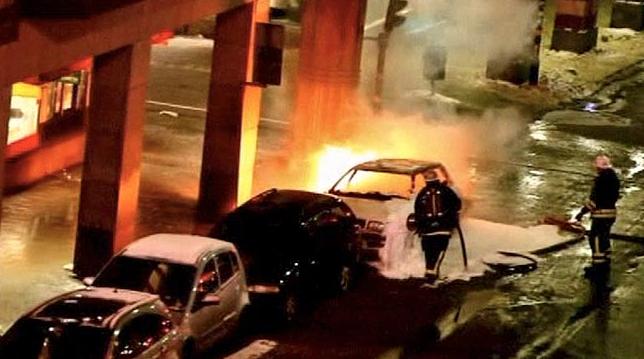
"Taimur of Sweden"
Until Taimour Abdulwahab al-Abdaly’s explosive belt went off prematurely in Stockholm last month, Sweden was the poster child for isolationism in the war on terror. While Abdulwahab’s bomb failed to achieve his desired result, it did obliterate the myth that nations can remain neutral to global terrorism.
Abdulwahab’s failed attack typifies the jihadis’ all-out war against “infidels.” He was a doctrinaire jihadist with ties to a local militant Islamist organization, and his attack didn’t spring up out of nowhere. There had already been warning signs that terrorists were mobilizing against the Scandinavian democracy. Militants had threatened Swedish artist Lars Vilks for his satirical cartoon portrayal of the prophet Mohammed, attacking his home and attempting to murder him with an axe. Others threatened Vilks.
The Iraq-born Abdulwahab was a member of the Facebook group “Islamic Caliphate State.” He lived in Luton in Bedfordshire, England, staging ground to four of the terrorists who killed 52 and injured more than 2,000 in the 7/7 train bombings.
Read More »
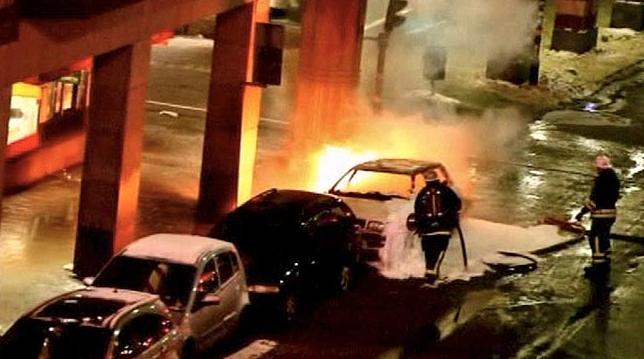
(Taimur the Citizen and the Jihadist: How to detect the difference?)
Swedish authorities claimed that Abdulwahab had been “completely unknown” to them before the blast, and that they were trying to ascertain when he was first “radicalized.” Swedish prosecutor Tomas Lindstrand said that the country’s security apparatus “was not a Stasi organization engaged in analyzing people’s Facebook pages.”
The irony is that Abdulwahab’s musings on Facebook are the only evidence of his radicalism prior to the attack.
Farasat Latif, the secretary of the Luton mosque to which Abdulwahab belonged, said, “Despite Abdulwahab’s extreme views nothing pointed to the fact that he was going to do something stupid.”
While not rock-solid evidence of a plot in the making, Abdulwahab’s “extreme views” were at least an indication that he was a potential danger to others. Contradicting his statement above, Latif added, “Soon Abdulwahab began making extremist statements focusing on suicide bombings.”
From Stockholm to Luton, confusion seems to be the order of the day. No one seems to be able to comprehend how Abdulwahab became radicalized, what his motives were, nor the extremist network in which he was radicalizing.
Abdulwahab arrived in Sweden as a child in 1992 and obtained a European passport. In 2001, he moved to Great Britain to study at the University of Bedfordshire in Luton, where a jihadi network was already growing. Between 2004 and 2007, his activities were unknown.
In late 2009, during a resurgence of jihadi actions in Europe, Abdelwahab appears to have joined the campaign on the Continent. In a recorded message he made before the attack and sent to the Swedish government and the TT news agency, he said, “I never went to the Middle East to work or to make money; I went for jihad.”
Last Sunday, the al Qaeda-affiliated Shumokh al-Islam website posted a message calling Abdulwahab a “brother” and quoted a prayer that says “God let me die as you are satisfied with me.”
European authorities have a lot of catching up to do. Whether or not they wish to admit it, they are at war. Even when jihadists act as “lone wolves,” they always have ties to some kind of radicalizing environment. The internet is always a vehicle for radicalization, but small cadres of global jihadists create the habitat that cultivates terrorists like Abdulwahab. Luton had been a known hotbed of radicalization since July 7, 2005.
The Swedes have now joined the community of nations besieged by Salafi terrorists. They may entertain notions of neutrality, but the jihadists who attack them don’t care.
Dr. Walid Phares is a senior fellow at the Foundation for Defense of Democracies and the author of the Confrontation: Winning the War against Future Jihad.
This Op Ed appeared first in The Caller today « Close It
December 27, 2010
A war of succession within AQIM
By Olivier Guitta
I just wrote an article for The National on the growing dissent within al-Qaeda in the Islamic Maghreb.
You can read the full article here.
Here is an excerpt:
Al Qa'eda in the Islamic Maghreb, or AQIM, has recently sought to raise its public profile with a series of successful kidnapping operations of western nationals. Its efforts have garnered attention not only from international terrorism analysts, but from militants themselves. After a September operation in Niger where seven people were kidnapped - including five French citizens - Osama bin Laden himself claimed paternity of this success.
Bin Laden's attention is noteworthy, but not the most revealing aspect of these strikes. For that, one needs to examine what members of AQIM are saying about their own activities, and how these tactics are creating rifts within the broader organisation.
The real mastermind behind the fall operation was Abdelhamid Abu Zeid, the head of the Sahel region. That Abu Zeid is claiming credit suggests he is looking to usurp control of AQIM from Abdelmalek Droukdel, the group's historical leader. This new situation could actually result in a war of succession inside AQIM.
This is not an entirely new development. Interestingly, Droukdel's leadership was already questioned in 2007 after the Algerian terror group GSPC (Salafist Group for Preaching and Combat) changed its name to al Qa'eda in the Islamic Maghreb. In fact, according to Abu Mossaab, the former head of the south who surrendered to Algerian authorities in August 2007, the dissent started as soon as Droukdel and two of his close advisers decided to join al Qa'eda without consulting the leadership and the group's base.
December 13, 2010
The Muslim Brotherhood in the MENA region
By Olivier Guitta
I wrote a paper on the Muslim Brotherhood in Jordan, Egypt and Morocco for the Center for European Studies.
You can download the full paper in pdf here:
Please do keep in mind it was written back in February 2010.
Please find below an excerpt:
The end of the 1920s found the Muslim world in total disarray due to the expansion of European colonialism and, even more importantly, the collapse of the Ottoman Caliphate and its replacement by a secular republic in Turkey in 1924. Al-Ikhwan al- muslimun, also known simply as the Ikhwan or the Muslim Brotherhood, was founded in 1928 by an unassuming Egyptian schoolteacher, Hassan al-Banna. The creation of the MB was to some extent a response to these two events, an attempt to fill the void and reunite the ummah (the Muslim nation).
Interestingly, the MB, a Sunni organisation, did not view itself as a political party but rather as a grassroots political movement engaged in mass mobilisation. Thus in order to gain access to the largest possible target audience, the MB created local branches and divisions for adults, youth and women. The MB also built schools, hospitals, factories and welfare societies, and distributed food so that it could attract a large following. This greatly helped al-Banna draw on the support of the small Egyptian bourgeoisie while enjoying very good relations with the Egyptian King Farouk, who saw the MB as a counterweight to Arab secular nationalists.2 The organisation gained in popularity by the day: indeed, from just six members at the start, the MB grew to 1,000 members in 1933, then 20,000 in 1937, 200,000 in 1943, 500,000 in 1945 and close to 2 million in 1951.
The MB is strongly hierarchical in structure, with numerous elaborate layers. At the top of the organisation sits the General Guide. The Arabic term, al-Murshid al-Aamm, indeed means ‘General Guide’, which differs considerably from ‘chairman’, the much more Western and neutral English translation used by the MB. This difference is itself sufficient to provide food for thought.
Amad Abdu Chaboune, the first Egyptian imam to be elected as a MB Member of Parliament, explained that if the government were to dismantle the first level of the organisation—that is, the level made up of leaders well known to the public—there would always be the second, third, fourth layers and so on, down to the last member of the Brotherhood. Indeed, from the beginning, the MB created numerous tiny cells— with no more than five members—and this made it almost impossible to dismantle.
The MB also had its own army and was the only effective resistance force against the British occupation of Egypt. Political violence started to increase in the late 1940s, and the MB paramilitary branch took part in it by perpetrating terrorist acts. In fact, this secret apparatus, which was approved by al-Banna, was behind the bombings of two Cairo movie theatres and the assassination of members of government, among other events. In 1949 al-Banna was murdered. Gamal Abdel Nasser seized power in a coup in 1952. Allies at first, Nasser and the MB later became competitors. Then, after an assassination attempt on Nasser in 1954, allegedly by a member of the MB, the regime first dissolved the MB and then imprisoned many of its leaders. Most of them were executed, including, in 1966, its most influential thinker, Saïd Qutb. Other MB leaders were able to flee. Most ended up in Saudi Arabia, but others found their way to Pakistan, Afghanistan, the Maghreb and Europe.
December 4, 2010
Azam Cheema: Lashkar-e-Taiba's Other 'Professor' Terrorist
By Animesh Roul
I just published one in depth report in Jamestown Foundation's Militant Leadership Monitor on Azam Cheema, LeT's intelligence chief, explosive trainer, jihadi recruiter and strategist who headed India operation.
"A Portrait of Azam Cheema: LeT’s India Strategist," Militant Leadership Monitor, Vol. I (11), November 2010.
Excerpt
Mohammed Azam Cheema (a.k.a. Baba/Babaji) is widely regarded as the “number three” of Lashkar-e-Taiba’s (LeT) anti-Indian operations. Azam Cheema has masterminded several high-profile attacks against India over the years from his safe haven in the dusty city of Bahawalpur in Pakistan’s southern Punjab Province on the edge of the Cholistan Desert.
.....
A militant strategist with years of deadly experience under his belt, Azam Cheema’s finger prints can be found on the majority of the LeT’s attacks on Indian soil prior to the November 26, 2008, Mumbai attacks. The Mumbai commuter train blast, however, remains his biggest operation so far. He always wanted to perpetrate several spectacular terror attacks in India, especially targeting major establishments by imparting jihadi training and pumping arms and ammunitions into Indian territory. Cheema’s in-depth knowledge of India’s vital installations and terrain coupled with a keen eye to assess the country’s vulnerabilities makes him a grand asset for Lashkar-e-Taiba despite his temporary quiescence.
For Complete Article Visit Jamestown's Website
December 3, 2010
PAKISTAN: US Treasury Designates LeJ and JeM Terror Masterminds
By Animesh Roul
The U.S. Treasury Department has designated three Pakistani terrorists on 02 December. They are anti-Shia and pro-taliban/AQ affiliate, Lashkar-e Jhangvi (LeJ)'s senior leader Amanullah Afridi and chief operational commander Mati ur-Rehman and Abdul Rauf Azhar of Jaish-e Mohammed (JeM).
Excerpts from the Press Release:
Amanullah Afridi
The chief of LJ and one of Pakistan's most wanted terrorists, Amanullah Afridi has been a key figure in directing terrorist-related activities of LJ for several years. As of November 2009, Afridi was the leader of a Karachi-based LJ group and, as of June 2009, the chief of LJ. Afridi is involved in numerous terrorist activities in Pakistan. He has prepared and provided suicide jackets for al-Qa'ida operations, trained suicide bombers and trained the assassin of Pakistani cleric Allama Hassan Turabi.
Mati ur-Rehman
One of Pakistan's most wanted terrorists, Mati ur-Rehman is the chief operational commander of LJ and has also worked on behalf of al-Qa'ida. In September 2009 he was identified as a planning director for al-Qa'ida and was linked to the August 2006 plot to destroy U.S.-bound British aircraft. As a leader of LJ, Rehman has been involved in multiple terrorist activities. He has led militants seeking to carry out attacks in Pakistan and was involved with a militant training camp in Pakistan. Rehman has also been implicated in plots or attacks against a former Pakistani president, a former Pakistani prime minister, and the U.S. consulate in Karachi.
Abdul Rauf Azhar
Abdul Rauf Azhar is a senior leader of JEM. As a senior leader of this terrorist organization, Azhar has urged Pakistanis to engage in militant activities. He has served as JEM's acting leader in 2007, as one of JEM's most senior commanders in India, and as JEM's intelligence coordinator. In 2008 Azhar was assigned to organize suicide attacks in India. He was also involved with JEM's political wing and has served as a JEM official involved with training camps.
November 19, 2010
Flawed Diplomacy: The United Nations and the War on Terrorism
By Matthew Levitt
On November 15, 2010, Victor Comras, Alistair Millar, and Brian Wilson addressed a special Policy Forum luncheon at The Washington Institute. Mr. Comras is author of the new book Flawed Diplomacy: The United Nations and the War on Terrorism (2010) and special counsel to the Eren law firm. Mr. Millar is director of the Center on Global Counterterrorism Cooperation. Mr. Wilson is the legal expert for the Analytical Support and Sanctions Monitoring Team of the UN's al-Qaida and Taliban Sanctions Committee.
Audio of this event can be found here . A rapporteur's summary of their remarks is available here.
November 16, 2010
Finally, Wheels Up for Viktor Bout
By Douglas Farah
Well, it took a long time and the road was filled with twists and turns, but Viktor Bout, accused of selling weapons around the world and busted trying to close a multi-million dollar deal with people he thought represented a designated terrorist organization, is finally on his way to stand trial in the United States.
Bout was arrested in Thailand in March 2008 after being taken in by a DEA undercover operation, where the Russian thought he was selling sophisticated weapons to the Revolutionary Armed Forces of Colombia (Fuerzas Armadas Revolucionarias de Colombia FARC), a designated terrorist organization by the United States and European Union, and one of the world's largest cocaine production cartels.
Among the things he offered the undercover operatives in the final meeting in Bangkok, believing them to be FARC commanders, were drones to attack U.S.-build radar stations, surface-to-air missiles, and the usual assortment of assault rifles and ammunition.
His arrest in the hotel, after taking more than an hour to regale the agents with promises of how he could help the FARC kill Americans, looked to be the end of the story. Thailand and the United States have an extradition treaty, the arrest was conducted jointly with Thai police, and the Thai foreign minister certified everything was in order. But legal wrangling, Russian state pressure and overall fear by the Thai government of crossing either the Americans or the Russians, led to a long and convoluted process.
However, the Thai cabinet on Tuesday swallowed hard and bravely approved the extradition, after more than two years of tussle, and Bout was put on a DEA plane, wheels up, and heading to the United States to stand trial in the Southern District of New York.
The arrest is more than symbolic in importance. It targeted one of the master facilitators who, through exploiting the rapidly changing world order, was able to be of use to multiple non-state armed groups, including often arming both sides of the same conflict. Many of these groups (the FARC, Taliban etc.) are terrorists, and almost all were criminal.
My full blog is here.
November 15, 2010
We Must Challenge the Ideology Driving Terrorism
By Matthew Levitt
Last week I was visiting Australia for meetings and lectures on a variety of issues, including combating violent extremism. Following up on that trip, my colleague Scott Carpenter and I wrote an piece in The Australian on this issue:
The recently foiled parcel bomb plot, tied to al-Qa'ida in the Arabian Peninsula, demonstrates today's persistent terror threat from abroad.
Yet Western democracies face an equally serious threat from home-grown terrorists. In the past two weeks, the US government unsealed charges against six men accused of funnelling money to al-Shabab, the Somali terrorist organisation responsible for the July 11 World Cup attacks in Kampala, Uganda. Three of the men are from San Diego, California, and three are Somali, one of whom lives in Missouri, one in Minnesota and one who is thought to be in Kenya or Somalia.
These indictments follow just three months after charges against 14 Americans for providing financial support and recruits to Shabab. Unsealing the indictments, US Attorney-General Eric Holder highlighted the sharp increase in home-grown radicalisation: "We are seeing an increasing number of individuals -- including US citizens -- who have become captivated by extremist ideology and have taken steps to carry out terrorist objectives, either at home or abroad."
Admirably, the Obama administration's May national security strategy explicitly lists as one of its goals "empowering communities to counter radicalisation." But without identifying the ideology driving radicalisation, it will be difficult to build community resilience against radicalisers.
The full article is available here.
November 12, 2010
The Further Narco-Terrorist Ties of the Chávez Government
By Douglas Farah
The August arrest of major drug kingpin Walid Makled a Venezuelan financial stalwart of the Chávez government in Venezuela has not drawn a great deal of attention here. But it goes to the heart of the criminal-terrorist nexus and its deep corruption that has permeated the Chávez government.
Makled was no small fish. He was designated a major drug kingpin by the Obama administration in 2009. But perhaps more importantly he and his brothers, owners of an airline and a major port, had saved the Chávez government in 2002, when the state oil company PDVSA went on strike.
After his arrest by Colombian police and DEA, Makled, who the Chávez government had suddenly turned on, decided to go public. In a series of TV interviews broadcast in Colombia Makled discussed his corrupt relationships with senior generals, the minister of interior (security) and other major figures in Chávez's inner circle. And, he had kept the evidence, including deposit slips in the banks, video recordings, audio recordings, etc. etc. For those of you who read Spanish, Teodoro Petkoff's TalCual summary here is very good.
To read the entire post, go to
November 8, 2010
The Ashburn jihadist signals a greater danger
By Walid Phares
Farooq Ahmed
The FBI's arrest of Farooque Ahmed of Ashburn, Va., for allegedly assisting al Qaeda in planning multiple bombings around the nation's capital paints a sobering picture of the threat we still face from jihadists.
The FBI charged the 34-year-old computer engineer, husband, father of one and naturalized U.S. citizen with "providing material support to terrorists and collecting information for a terrorist attack." Emphasizing the gravity of the case, U.S. Attorney for the Eastern District of Virginia Neil H. MacBride remarked that Mr. Ahmed was "accused of casing rail stations with the goal of killing as many Metro riders as possible through simultaneous bomb attacks."
Throughout the summer and fall, U.S. authorities witnessed a significant rise in jihadist activity, using increasingly sophisticated operational strategies. According to open-source reports, between 2001 and 2008, U.S. agencies stopped one or two terror attempts a year. However, from 2009 until today, the government has been uncovering one or two cases a month, a troubling growth in jihadi activities.
Read More »
The deep concern of citizens and law enforcement personnel is understandable, but the concern is not merely that a man from Ashburn purportedly is engaged in terrorist activities, but rather that there is jihadi activity in the United States at all. The information available on jihadi operations around the United States suggests that authorities are witnessing a coordinated terrorist strategy that focuses on our urban centers.
The FBI's indictment states that Mr. Ahmed agreed to conduct surveillance and take photographs of the Arlington Cemetery Metrorail station and a hotel in Washington for the purpose of gathering information about security and the sites' busiest periods. Mr. Ahmed allegedly also participated in surveillance, recording images of the Arlington Cemetery Metro station on July 7.
The following month, Mr. Ahmed is said to have participated in surveillance of the Courthouse, Pentagon City and Crystal City Metrorail stations just outside Washington. These descriptions of Mr. Ahmed's tasks correspond to calls by al Qaeda leaders to conduct strikes in U.S. cities and to similar actions the group and its affiliates have undertaken in many parts of the world.
"During a meeting at a hotel in Herndon, Virginia, on Sept. 28," the indictment reads, "[Ahmed] suggested that rolling suitcases be used instead of backpacks, and he said that he wanted to kill as many military personnel as possible."
The plan closely resembles past attacks, such as the train bombings of Madrid in 2004 and London in 2005. More important, the plot is consistent with the standing orders of al Qaeda and other jihadists to attack U.S. military personnel.
The planned attacks appear to reflect an undeniable devotion to jihadi ideology. "Between April 2010 and Oct. 25," the indictment reads, "Ahmed repeatedly met with individuals he thought were affiliated with al Qaeda to discuss 'jihad.' "
"On May 15, in a hotel room in Sterling, Virginia," it continues, "Ahmed told one individual that he might be ready to travel overseas to conduct jihad, but only after he completed the Hajj pilgrimage to Saudi Arabia in November."
U.S. authorities still struggle to understand the jihadists we face and how are they indoctrinated. Though they have not all traveled through the same physical locations, they share inspiration from al Qaeda leaders and supporters, including Ayman al-Zawahri, Anwar al-Awlaki and Abu Musaab al-Suri. Radicalization produces urban terror. From ideological incitement come cadres of jihadists committed to action.
How many terrorists are involved in similar activities around U.S. urban centers right now? As the arrests accumulate, they sound a warning that the number of jihadists inside the United States is growing and the would-be bombers are preparing attacks more difficult to foil than any before.
America is well-served by its law enforcement and national security officials, who have succeeded in stopping the overwhelming majority of planned strikes. They are our last line of defense. But they can't be everywhere at once, and the jihadists know it.
Dr Walid Phares is a senior fellow with the Foundation for Defense of Democracies and the author of "Future Jihad: Terrorist Strategies Against America"
This article was also published in the Washington Times « Close It
CHICAGO BOMB PLOT: INTERNATIONAL COOPERATION IS NOT COST FREE
By Michael B. Kraft
International cooperation is key in fighting international terrorism – this has been a theme of U.S. government counterterrorism statements and talking for decades.
This concept was underscored by the thwarting two weeks ago of a terrorist plot to ship two bomb-laden packages to the United States, with the apparent intention of blowing them up over an American city or upon delivery to Jewish institutions in Chicago.
(The plot prompted the US government today to impose a ban on cargo shipments from Yemen.)
Yet, future international cooperation could be undermined if the post-election political climate in Washington results in budget cuts for foreign aid programs that help strengthen friendly countries and international cooperation.
According to U.S. officials, Saudi Arabia officials had given the U.S. earlier warnings of a potential but unspecified attack and then later quickly passed on additional details when received from their inside source, reportedly a “turncoat.” Abu Dubai officials found one bomb device, hidden in a computer printer toner cartridge, before it was loaded onto an outbound plane. British authorities found the second after it already had been flown on one plane and was awaiting transshipment from a British airport to the U.S. It was a good example of international cooperation, described in detail by Canadian Press.
There have been numerous other incidents involving international cooperation, some publicized --including Jordan thwarting plots to blow up an American hotel in Amman and cooperation among the Europeans in countering the current reports of potential attacks. There also is good bi-lateral cooperation, such as between France and Spain to counter the Spanish ETA terrorist group whose members move across the border and others that have not been publicly disclosed. Good cooperation, some of which has not been made public, also exists between the U.S. and Asian and African countries.
As Tom Ridge, the first Secretary of Homeland Security said last week at the Homeland Security Policy Institute, even in cases where countries strongly disagreed with American policies, the security and intelligence agencies cooperated “hands in glove” with the United States.
Read More »
He was not specific, but may well have had in mind Saudi Arabia and some other Middle Eastern countries. In addition, despite the policy disagreements with some European countries concerning the U.S. invasion of Iraq and other issues, intelligence and law enforcement agencies remained good.
An interesting sidelight of the recent bomb plot is that although the bomb parcels were addressed to a synagogue and another Jewish institution in Chicago, the tip that thwarted prevented the attack came from Saudi Arabia. One bomb package was detected in Abu Dubai. Both Arab countries and their media are opposed to Israel and their media attack Jews. Whether the Saudis were aware of the addresses or that the bombs were -- according to British officials-- apparently rigged to explode via a timing mechanism before reaching the Chicago Jewish institutions is unknown. Regardless, they apparently cooperated quickly
Bin Laden's original target, for those who forgot, originally was the Saudi Kingdom because it hosted American and other “infidels” before Saddam Hussein was defeated in Iraq. The plot was claimed by Al Qaeda in the Arabian Peninsula, an affiliate of the main Al Qaeda.
FOREIGN ASSISTANCE STILL NEEDED
Yemen, one of the world’s poorest and most unstable countries, is becoming a major recipient of U.S. counterterrorism, military, and economic aid, such as development assistance and child survival programs.
It is one of the many countries in the developing world that have poor economies, shortages of jobs and poor education and legal systems, where terrorists have obtained footholds and attacked American targets or friendly host nations. The Chicago parcel bombs and the Christmas Day underwear bomber plots originated in Yemen, terrorists used Kenya and Tanzania to bomb the US embassies in Kenya and Tanzania in 1998 and other fundamentalist attacked Australian and other western tourists in Bali and Jakarta, Indonesia.
Countries with weak governments and sometimes volatile political situations are vulnerable to being used by terrorists, either as staging grounds for attacks elsewhere or attacks on embassies or other foreign presences. Claiming that poverty or despair is the main or cause of terrorism, is one of these myths fashionable in some circles—many terrorism leaders come from well-to-do backgrounds. I don’t buy it. But terrorists have found fertile recruitment grounds where governments are weak and there are large numbers of young men who cannot find jobs and a sense of self worth except, in their eyes, by joining a radical fundamentalist cause.
Basically there are two aspects of U.S. foreign assistance that can help counter terrorism. The first includes the more general programs such as development assistance and economic support funds which are intended to help strengthen the recipient country as a whole. These funds are in greatest danger of being slashed by the new Congress if members take a wide sweeping approach to cutting federal budgets instead of evaluating programs on their merits.
The other aid programs are more specialized. For example, the State Department’s Antiterrorism Training Assistance (ATA) Program that helps strengthen the capabilities of law enforcement officials in friendly countries through such courses as explosives detection, airport security and crisis management. Using State Department budget funds, Treasury, State and Justice run programs to help other countries, including those in the Gulf, to counter terrorism financing. Similarly, the State Department, the Justice Department and FBI provide various programs to improve law enforcement and strengthen legal systems and the Defense Department has its specialized programs.
Some of these are relatively small and often overlooked in the complex budget. F or example, the State Department’s ATA program, which has often been cut in one House or another as part of across-the board cuts, is seeking $205 million for FY 2011. The final appropriation is expected to be decided in an omnibus appropriations bill awaiting the “lame duck” session as Congress failed to pass most of the individual appropriations bills before the election.
The State Department also is developing a new program to counter radicalization. The Department’s Coordinator for Counterterrorism, Ambassador Daniel Benjamin, has told Congress that the program is needed “to keep those at risk of radicalization from becoming violent “ and “to beat back the Al Qaeda narrative.” The administration is seeking $15 million to fund counter-radicalization efforts in high priority countries. Current indications, judging by the House Appropriations Committee, are that if the initiative is funded, Congress will cut the funding request by two thirds, to $5 million. Yet, countering the radicalization of susceptible men and women is an important necessity in countering Islamic fundamentalist violence.
Strengthening international cooperation against terrorism has taken many years of diplomatic effort –predating 9/11-- in bi-lateral one-on-one meetings with other countries, in multilateral settings such as INTERPOL and international summit meetings and direct contacts and relationships between intelligence services and law enforcement officials. But it also takes money -- a very small part of the overall U.S. budget-- for programs to strengthen the economic and national security of friendly countries who often are the first line of defense for American citizens, whether and home or abroad.
This is part of the reality of good government and national security that cannot be overlooked now that the midterm Congressional elections are over. The counterterrorism effort is not a simple matter of Defense Department military actions, or Homeland Security’s work within our borders. Cooperation with our international partners, and our efforts to build up their capacity to fight terrorism themselves, is critical to the long-term effort to make Americans safer.
Members of the new Congress will have to get beyond slogans and deal with the world as it is, where bombs and weapons of mass destruction can come packaged and transported in many diverse ways. « Close It
November 5, 2010
Bin Laden and France
By Olivier Guitta
Last week Osama Bin Laden devoted an entire message addressed to the "French people".
Since it is a first, I wrote for The National about the actual threat that AQ poses on France.
Here is an excerpt:
France has been at an unusually high level of alert over the past few weeks. Multiple terror warnings derived from credible intelligence sources have convinced the French authorities to warn the public of an imminent threat. And, as if that were not enough, Osama bin Laden recently delivered a taped message that was devoted to France.
The French are now in rare company. Bin Laden had before only devoted the entirety of one of his diatribes to one other country, the United States. His recent message and the reasons behind the heightened state of alert in France raise the question whether France has become al Qa'eda's top priority, and if this is the case, why?
Al Qa'eda's leadership has mentioned France consistently since they began delivering audio and video messages. But usually France has been mentioned in passing and alongside a slate of other countries. Still, the organisation has been consistent in its justifications for animosity against France: the presence of French troops in Afghanistan, the passing of a law in 2004 banning religious symbols in French public schools, and the "colonial" attitude of France in North Africa.
You can read the rest here.
October 26, 2010
Feds Nab Suspected Terror Traitor In the Making
By Bill West
Federal agents in Hawaii on Friday arrested an American born Muslim named Abdel Hameed Shehadeh based on a federal criminal complaint issued in Brooklyn, New York charging him with making false statements to federal officials in a matter involving international terrorism.
The complaint alleges the 21 year old Shehadeh lied to investigators on several occasions about the purpose of his travel to Pakistan, that he claimed he was going to attend a religious school when his real intention was to join the Taliban and fight U.S. military forces. When those efforts failed because he was denied entry into Pakistan, Shehadeh tried to join the U.S. Army with the intention of being deployed to Iraq and deserting and joining the Islamic insurgency there to fight against the American military. Shehadeh, according to the complaint, was denied enlistment into the U.S. military because he lied to the Army recruiter about his previous attempted entry into Pakistan.
The federal charges state Shehadeh constructed jihadist websites that contained postings by wanted American born al-Qaeda operative Anwar al-Awlaki and al-Qaeda leader Ayman al-Zawahiri. Those websites were linked, among others, to Revolution Muslim, described in the charging complaint as “a radical group based in New York that has expressed its agreement with the ideologies of al-Qaeda and other terrorist organizations.”
The complaint identified an email address associated with Shehadeh as “[email protected].” The complaint explained the term “mujahideen” as meaning “Muslim guerrilla warriors engaged in a jihad.” The term “jihad” is referenced numerous times in the complaint in the obvious context of terrorism, or the more commonly known definition of “holy war.” The affiant FBI Special Agent further stated that based on his training, experience and interviews of cooperating witnesses, he knew that fighters for al-Qaeda refer to themselves as “mujahideen.”
The explanation of the jihadist terminology contained within the criminal complaint is noteworthy, as it demonstrates an official recognition by Federal law enforcement engaged in counter-terrorism investigations the true nature of these terms as used and understood by the terrorist enemy, as opposed to the obfuscation of those terms espoused by many of the apologists for those same jihadists.
Investigative Project on Terrorism Rejects Allegations by Tennessean, CAIR
By The Investigative Project on Terrorism (IPT)
In an article in Sunday's Tennessean newspaper of Nashville, Tenn., reporter Bob Smietana made a series of unsupported claims about the nature of the Investigative Project on Terrorism and our work.
There's a price that comes with erroneous reporting and we're seeing it register already. The Council on American-Islamic Relations (CAIR) issued a news release calling for an IRS investigation into our status as a non-profit organization. We believe we can withstand any scrutiny.
This isn't a surprise. Groups have been stung repeatedly by our ability to pierce their fog of deception and show their ties to radical Islam, including support for Hamas and other terrorist groups. That's especially true for CAIR. We broke the news that the FBI cut off contact with them because of court evidence tying the organization and its founders to a Hamas-support network. It's in CAIR's interest to deflect attention from that fact and the disclosures which led to it. Trying to discredit the IPT is a sure way to do that.
We won't let them silence us or make us go away. We also realize when you specialize in the work we do, you make enemies. We've earned them the hard way, through diligent research that relies on public documents and what the elements of radical Islam have said publicly. They have hated us for it for years and have found a naïve reporter willing to buy their line.
At issue in the Tennessean story is the relationship between the IPT Foundation, a tax-exempt charity, and SAE Productions, a for-profit company run by IPT Executive Director Steven Emerson. The foundation accepts private donations and contracts with SAE to manage operations. The Tennessean article pays only lip service to the legitimate security issues that dictated this structure and that the IRS has reviewed and approved it.
The article says the foundation's "tax-exempt status is facing questions," implying that someone other than the Tennessean and the paper's hand-picked analysts are raising those questions. This is presented as something that is already happening outside the realm of the newspaper and its talking heads. There is no indication the discussion goes any further.
We provided the newspaper with our 1023 application for tax-exempt status and with our 2008 tax return, most commonly called a form 990. The documents show that we told the IRS we were contracting out our management with a group that did not have tax-exempt status. That was approved. As for the for-profit nature of SAE Productions, the IRS is aware of that as well. That has not been questioned. We say IPTF contracts out with SAE Productions, which files tax returns with the IRS. All of that has been disclosed.
Our application was submitted with the assistance of attorneys and accountants, including one with 20 years of experience with the IRS in exempt organizations.
Smietana appears to have misunderstood one of the questions the IRS asked about our application. He writes:
In a letter dated Dec. 8, 2006, the IRS asked if there would be any ties between the subcontractor and the Investigative Project on Terrorism Foundation. On Dec. 29, 2006, Emerson wrote back: "There are and will be no financial/business transactions between officers, board members or relatives of the aforementioned and applicant organization."
That miscasts the IRS's question which can be seen on page 32 of the documents provided to the newspaper. The IRS asked whether there will be "any financial/business transactions between officers, board members, or relatives" of the foundation and its contractor. There is none. The IPT Foundation pays SAE Productions for management, which includes our rent, research expenses, salaries and benefits for our employees.
It may be confusing and it may be unusual, but there is nothing inappropriate about it.
"Charities certainly can pay for profit organizations for providing work for them as long as it's at fair market value and furtherance of the organization's exempt purposes," said Edward Coleman. Coleman spent 20 years working with the Internal Revenue Service working on exempt organizations, including five years as director of the Exempt Organizations Division at the IRS national office. He was among the accountants and lawyers who advised the IPT Foundation in its application for tax-exempt charitable status.
Read our full posting here.
October 24, 2010
Financial Sanctions Targeting Iran
By Matthew Levitt
In October 2010, the United States Institute of Peace, in conjunction with the Woodrow Wilson International Center for Scholars, published The Iran Primer: Power, Politics, and U.S. Policy, a unique publication by fifty of the world's top scholars on Iran representing some twenty foreign policy think tanks, eight universities, and senior foreign policy officials from six U.S. administrations. With no single political agenda, the publication presents a wide range of perspectives on diverse aspects of Iran's politics, economy, military, nuclear program, and society. The volume probes Iran's foreign relations with a dozen nearby countries or regions, chronicles U.S.-Iran relations under six American presidents, and presents the West's options for dealing with Iran in the future.
My own chapter, on "Financial Sanctions" is available here, along with chapters penned by several of my Washington Institute colleagues.
Lashkar-e-Taiba's Strategic Positioning vis-a-vis India
By Animesh Roul
I published one report [Lashkar-e-Taiba and the Strategy of “Encircling” India”, Terrorism Monitor (Jamestown Foundation), October 21, 2010] on the growing ambition and strategic positioning of Lashkar-e-Taiba vis-à-vis India, especially in the neighboring countries.
Here is an excerpt:
Within a span of six days, Bangladesh authorities arrested four high profile LeT operatives with smuggled exotic dutiable products and large amounts of explosives and other bomb making materials. The detainees included Khurram (a.k.a Mohammad Salem), LeT’s chief coordinator (Daily Star [Dhaka], Oct 05). The latest arrests revealed that LeT operatives use Bangladesh as a transit point for counterfeit currency and as a fertile ground for jihadi recruitment.
....
India’s Ministry of Home Affairs claimed earlier this month that hundreds of Naxalites (Maoists) from India were being trained in Nepal by Nepal’s People’s Liberation Army (PLA) and supervised by LeT operatives Latif Khan and Razzaq Ansari (Indian Express, October 11). Pushpa Kamal Dahal (a.k.a. Prachanda – “Fierce One”), chairman of Nepal’s Unified Maoists’ Party, suggested the claim was fabricated and formed part of an Indian attempt to disrupt the peace process initiated in 2006 to end a 10-year civil war and the drafting of a new Nepalese constitution. [...]. Earlier this year, a detained former LeT financier, Umer Madani, told interrogators that he had been asked to open ties with the Naxalites while based in Nepal but failed to establish any useful ties before his arrest in June 2009 (Indian Express, May 28).
....
In Sri Lanka, a recent accidental blast of two Chinese containers of dynamite that destroyed the police station they were stored beside raised eyebrows in regional intelligence and security circles (Colombopage.com, September 18; Lanka Daily News, September 18). Though the blast in Karadiyanaru (Eastern Province) had the appearance of an industrial accident (Chinese workers were attempting to move one of the containers at the time), there were unsubstantiated claims that the containers (belonging to a Chinese construction company doing development work in the Eastern Province) were actually scheduled to be transported through Oluvil port to Pakistan and ultimately into the hands of LeT (Lanka News Web, September 29).
......
If the confession of Sabahuddin Ahmed, accused in the Mumbai attacks (but acquitted for lack of evidence), is to be believed, a Maldivian named Ali Ahsham did the reconnaissance on targets in Bangalore before the December 2005 attack on the Indian Institute of Sciences (Times of India, February 4). In Maldives too, LeT’s charitable front, Idara Khidmat-e-Khalq (IKK), which operated in the aftermath of the 2004 tsunami under the guise of providing humanitarian assistance, has successfully influenced youths to join the so-called jihadi struggle and turn Maldives into a jihadi recruiting ground (see Terrorism Monitor, February 14).
Read the complete article here.
October 15, 2010
Obama's National Security Vision: Confronting Transnational Threats with Global Cooperation
By Matthew Levitt
The Obama administration's May 2010 National Security Strategy (NSS) laid out a strategic vision that draws on interagency information sharing as well as active engagement with foreign partners to secure American interests. This multilateral approach is likely to succeed in the tactical areas of counterterrorism and counterproliferation. But given the emergence of several critical national security threats -- including Iran's nuclear program and the emerging danger of "homegrown" terror -- the long-term challenge remains considerable. Will the administration's national security vision translate into strategic success?
Obama's National Security Vision: Confronting Transnational Threats with Global Cooperation, the fourth compilation in the Stein Program's lecture series by senior counterterrorism officials, tracks the evolution of U.S. counterterrorism and counterproliferation policy during the Obama administration's first two years, with particular focus on the 2010 NSS and its implementation by various government bodies. As U.S. officials strive to keep up with the ever-changing tactics of adversaries, the administration's formidable goal of reshaping the current strategic environment demands the kind of timely analysis and creative ideas compiled in this volume.
Offering their unique insights and perspectives:
* Matthew Levitt (editor), Director of The Washington Institute's Stein Program on Counterterrorism and Intelligence
* John T. Morton, assistant secretary of Homeland Security for U.S. Immigration and Customs Enforcement (ICE)
* Todd M. Rosenblum, deputy undersecretary of Homeland Security
* Daniel Benjamin, coordinator for counterterrorism, State Department
* David Cohen, assistant secretary for terrorist financing, Treasury Department
* Steven Pelak, national coordinator for export enforcement, Justice Department
* David T. Johnson, assistant secretary of state, Bureau of International Narcotics and Law Enforcement Affairs
The complete monograph is available here.
October 11, 2010
Team Petraeus: Taliban 'Comfortable And Safe In Pakistan'
By
Where are the Taliban and their one-eyed leader Mullah Omar hiding out? Where is the Afghan Haqqani network now based?
The answer, of course, is Pakistan. It used to be a dirty little secret no one spoke about publicly. That changed in the past few years, but an apparent U.S. blunder involving an airstrike inside Pakistan that killed two of its border scouts could knock such overt criticism of our paradoxical ally off the table again.
The U.S. military once helped prop up Pakistan’s shaky regimes by refusing to publicly acknowledge its ally’s army and intelligence service had internal elements who collaborated with the enemy. After Army Gen. David Petraeus took over NATO forces in Afghanistan on July 4th, however, the diplomatic niceties eased after years of “See no evil,” and pressure mounted on Pakistan’s army to hit the Taliban like they meant it.
The Obama administration has leaned hard on Pakistan’s current government about Al Qaeda and Taliban sanctuaries — or as hard as anyone can with a stubborn republic fretting over India’s expanding influence.
Petraeus’ staff has applied its own pressure on Pakistan in almost daily blunt public statements spotlighting the embarrassing fact that the Taliban’s base of operations and command and control are not even in their own country. The trend of calling out Pakistan has continued despite Petraeus’ near-apology on Wednesday for the Pakistani border guards’ accidental killings by a NATO chopper last month, which he said “we deeply regret.”
Click here to read my full post at the New York Daily News.
October 8, 2010
Profile of Zakir Naik: Controversial Islamic Orator With Influence in the West
By Madeleine Gruen
The NEFA Foundation has released the fourth report in its series on extremist ideologues with influence in the West. This report profiles Zakir Naik, a Muslim orator from Mumbai, India, who has millions of fans around the world, including many in the U.S., that he reaches through live lectures and through his satellite television station, Peace TV.
His enormous popularity is due to his exceptional speaking and memorization skills. He is able to quote the Koran, the Bible, the Torah, and other religious texts, chapter and verse, and impresses audiences with his ability to cite numerous examples to support such claims as, apostates should be put to death, and it is acceptable for a man to beat his wife under certain circumstances and with specific techniques. Although Naik often makes such religious pronouncements he is not a formally trained religious scholar, and has been labeled “deviant” by some orthodox clerics.
While Naik is regarded as controversial by many observers and several government agencies (he has been banned from entering Canada and the UK), he does not publicly or overtly promote violent jihad. However, he bears observation because he insinuates that violence perpetrated against Americans is acceptable, and he has made statements that suggest he is in agreement with terrorist attacks that have taken place in the past. He was a source of inspiration to Najibullah Zazi, who plotted to attack the New York City subway system, several of the attackers and planners of the 2008 Mumbai massacre, and others charged with involvement in terrorism. He also promotes the theory that the 9/11 attacks were planned and coordinated by the U.S. government in order to gain control over oil-rich countries.
The full report can be read here.
September 30, 2010
Getting a Better Handle On Terrorism Financing
By Victor Comras
On Tuesday (Sept 28th) the House Subcommittee on Financial Oversight and Investigations held hearings on Current and Evolving Trends in Terrorism Financing. The Subcommittee members were particularly interested in the effect of US efforts to combat terrorism financing. I had an opportunity to testify at these hearings and to describe some of the more serious shortcomings A copy of my testimony is contained below:
Read More »
We have just passed the 9th Anniversary of the terrible 9/11 attack that confirmed for us, and for most of the international community, that international terrorism poses one of the gravest threats to international peace and security. Yet, despite this confirmation, funds continue to flow to those engaged in indoctrinating, recruiting, and training terrorists and for terrorist operations.
Some have suggested that we have, in fact, already put a real crimp on terrorist financing. But, the threat posed by the international terrorists has not diminished. And, empirical evidence demonstrates that many of these terrorist groups, including al Qaeda, the Taliban, Hamas, Hezbollah, Lashkar-e-Taiba, and other groups associated with al Qaeda, continue to have access to sufficient funds to maintain their organizations and their terrorist operations. If anything, Taliban funding is expanding, not diminishing.
While the Taliban’s cash flow from Afghanistan’s poppy fields comes as no surprise, the amount of foreign donations they continue to receive is a real eye opener. According to the CIA (as reported in the Washington Post), Taliban leaders and their allies received some $106 million in the past year from donors outside Afghanistan. Much of these funds are drawn from the same donors in Pakistan, the Gulf region, Southeast Asia and Europe that long supported al Qaeda. And these supporters continue to include a variety of Muslim fundamentalist organizations and charities, as well as wealthy Al Qaeda/Taliban supporters.
Hamas has also developed its own worldwide network for soliciting funds to support its activities, including terrorism-related operations. Hamas, which has close links with the Muslim Brotherhood, is also still able to use front companies and well-established banking links in much of the world to openly collect such funds from organizations, donors, and from over the internet, and to transfer these collected funds to Hamas operatives through well established channels.
There is also a growing nexus between terrorism and transnational crime. The Taliban, FARC and several other international terrorist groups draw heavily on funds generated from the illicit drug trade and other criminal activities, including petty crime and credit card fraud, and even Hamas has turned to the illicit drug trade emanating from the tri-border region in Latin America to surreptitiously acquire additional funding. West Africa and Southeast Asia are also emerging as other potential regions for this crime-terrorism convergence.1 And these nexus rely heavily on money laundering techniques to enter these funds into established financial transfer channels.
I know, Mr. Chairman, that U.S. financial institutions take the threat of international terrorism very seriously. They have come a long way since 9/11 in putting in place effective procedures to identify, report, and/or to block suspicious transactions. Extensive transaction filters have been put in place and “due diligence” and “know your customer” have become regular catchwords for compliance officers spread extensively throughout our banking and financial system. And, US Government regulatory oversight is now both intensive and vigilant.
So, what is lacking?
Well, Mr. Chairman, the fact is that US Banks are intricately networked into an international banking system that has not yet fully come to terms with halting terrorism financing. And, while we have made great strides in cutting off the flow of money for terrorism from the United States, our banks remain awkwardly vulnerable to getting caught up in handling terrorist group-related transactions that originate overseas. This is because US banks must so heavily rely on the veracity and accuracy of the transactional information provided to them by their overseas clients and associates.
Following enactment of the increased “due diligence” and “know your customers” requirements contained in the Patriot Act, US banks moved quickly to re-assess their relationships with the foreign banks with whom they maintain a correspondent relationship. They had to assure themselves that these foreign banks were also taking the steps necessary to vet their clients and that they would accurately record and pass on required transactional information, including the correct identification of the beneficial parties involved. But, the fact is that this is not always the case. And, in the fast and very competitive world of international financial transactions, these assurances are often shortchanged. Our banks must also rely heavily, therefore, on any cautionary information that our public sector regulatory agencies, such as Fincen, OFAC, and other relevant Treasury Department offices share with them. This cooperative relationship and information sharing is essential, and needs to be formalized.
Today, when US banks have doubts about the legitimacy of transactions they are required to file suspicious activity reports with FinCen. In most cases they still permit the transaction to be processed. However, when their doubts suggest the possibility of terrorism financing, they will usually place some kind of hold on the transaction.
US Depository Institutions filed some 15,500 suspicious wire transfer reports in 2009. Of these, only about 545 involved possible terrorism financing concerns. How well they are actually doing in discerning such terrorist-related risks remains any ones guess. Nevertheless, the number of suspicion-of-terrorism SARS did increase some 8 percent last year.
Considerable strides have also been made with regard to the regulation and oversight of the myriad money services businesses operating in the United States. This sector has seen exponential growth in the volume of international financial transfers. We must recognize, however, that at least one part of this sector – the informal mom and pop transfer mechanisms, such as Hawala, lack the wherewithal to closely vet the transactions they handle and they remain particularly vulnerable to being used to handle terrorism related transfers. Here too, much of the problem resides overseas. Funds transferred through Hawala like systems are very hard to trace, particularly as they are re-directed once they are received overseas. Terrorist organizations have become sufficiently sophisticated in handling such transactions to assure that the initial overseas recipient of the funds appears squeaky clean.
Let me suggest, Mr. Chairman, that it is essential that we broaden the focus of our attention, when it comes to inhibiting the financing of terrorism, to include financial institutions beyond our shores.
When I say that the locus of the terrorism financing problem is largely overseas I do so with a caveat. A number of foreign financial institutions that maintain branches and correspondent accounts in the United States have engaged in banking activities that have become of grave concern to us.
In August 2005, the New York branch of Jordan’s Arab Bank signed a consent decree, and paid a $24 million penalty, for its involvement in transferring more than $20 million to and from more than 45 suspected terrorists or terrorist groups in the Middle East. The bank acknowledged that it had dollarized many of these transactions. In April 2009, Doha Bank, New York paid a civil penalty of $5,000,000 which was assessed, in part, because of its involvement in dollarizing transactions related to terrorist groups overseas.
There have been several other cases involving US branches of foreign banks that have engaged in practices inconsistent with U.S sanctions laws and regulations. Last May a criminal information was filed against, ABN AMRO, now part of the Royal Bank of Scotland, for facilitating transactions by altering or stripping information from the transactions so that they might pass undetected through compliance filters at other U.S. financial institutions. These transactions involved more than $3.2 billion dollars moving to, from, and through AMB AMRO’s New York branch. And, in December 2009, Credit Suisse was assessed a $536 million penalty for processing thousands of transactions over a 20-year period that concealed the involvement of sanctioned parties and the routing of wire transfers and securities transactions to and through the United States.
These regulatory actions have sent a strong message to overseas financial institutions that the United States will not countenance such activities on the part of their branches in the United States.
But, an even stronger message is now being sent by victims of terrorism as they move in U.S. courts to hold such financial institutions accountable under section
2333 of the anti terrorism act for facilitating the flow of funds to terrorist organizations. I cite as examples the civil damages cases now proceeding in New York against Arab Bank, Nat West, and Credit Lyonnais for their having facilitated the transfer of funds to Hamas and other terrorist groups that have launched suicide and other terrorism attacks against innocent victims in Israel.
The real problem here is that while these terrorist related transactions are illegal in the United States, they have not been deemed illegal by many of the other countries in which these banks operate. This is in spite of the fact that almost all countries are now parties to the International Convention for the Suppression of the Financing of Terrorism, which came into force in April 2002. That convention clearly obligates all countries to criminalize the funding of groups or individuals that engage in terrorist activities.
Shortly after the 9/11 attack the Security Council also adopted resolution 1373 which obligates all countries, whether or not they have adopted the Terrorism Financing Convention, to take the steps necessary to prevent the transfer of funds to terrorist organizations or for terrorist purposes. But, the resolution failed to contain any definition or criteria as to what constitutes terrorism. It left it to each country, independently, to determine this crucial issue for itself. Without common criteria, or a definition of terrorism, each country remains free to interpret its own obligations. Each can decide which groups they consider terrorists and which they wish to hail as “freedom fighters.” Saudi Arabia uses this distinction, for example, to justify its continuing funding for Hamas while Iran and Syria use it to provide funds and support to Hezbollah.
The fact of the matter is that there is still only a very limited international consensus as to which organizations are terrorist organizations. And, for the most part, that consensus is limited to a very short list of entities and individuals identified and designated by a Committee of the Security Council, as being directly associated with al Qaeda and/or the Taliban.
At my own last count, in June 2010, that designation list includes 137 members of the Taliban, 257 members or associates of al Qaeda, and 103 entities directly related to al Qaeda. I want to be clear on this point. Beyond that list of designated individuals and entities there is no international consensus, and therefore, no clear and enforceable international obligation, which inhibits countries from allowing their financial institutions to engage in financial transactions with such undesignated individuals and entities.
Only a limited number of countries have joined with us in designating such organizations as Hamas and Hezbollah as terrorist organizations. This includes, for the most part, our European friends and allies. Yet, some European countries still exempt the political and humanitarian wings of these organizations from such designation. Many other countries have not even gone that far and openly permit their financial institutions to process transactions in Hamas’ and Hezbollah’s favor.
Given US bank interaction with this larger international banking community, the vulnerabilities become stark. And, that means that very careful attention must be paid to assuring that accurate information regarding origination and the ultimate recipient of the transaction is complete and accurate.
The problem is further complicated by the emergence in numerous lesser developed countries of new under-funded and under-regulated home grown banks. These banks rely heavily on their correspondent and payable through accounts maintained in more established banking institutions. Many of these home grown banking institutions continue to lack the wherewithal to mount and maintain an effective compliance system. At the same time the national regulatory environment under which they operate is unable to provide effective oversight. And, many of these banks are located in areas quite susceptible to the recruitment of terrorists.
So, Mr. Chairman, I would also place great emphasis on the need to strengthen the international banking communities resources and commitment to halting the financing of terrorism.
I do not want to appear too pessimistic in this regard. A very substantial segment of the international banking community does take terrorism financing and money laundering issues quite seriously. The Wolfsberg group of banks, for example, has established high standards to prevent terrorist organizations from accessing their financial services, and they have pledged to assist governments in their efforts to combat terrorist financing.
There are also a number of other activities underway to upgrade international compliance capability. FATF, The Financial Action Task Force, has made great strides in providing guidance and best practices for the strengthening of international banking compliance, and in brokering assistance for jurisdictions wishing to upgrade their compliance programs. It has also spawned numerous regional organizations to facilitate cooperation and share the burden of compliance among their member banks.
FATF has also finally gotten back to holding certain countries accountable for their failings in this regard. In 2008 FATF began publishing a list of high risk and non cooperating jurisdictions whose banks have failed to adequately implement an anti-money laundering and counter terrorism financing program. FATF issued a series of statements expressing concerns about the AML/CFT deficiencies in Iran, Uzbekistan, Pakistan, Turkmenistan, São Tomé and Principe, and the northern part of Cyprus.
The FATF statements called on FATF members to pay special attention to transactions dealing with Iran and Uzbekistan and to strengthen preventive measures in response to the risks associated with these countries. In February 2009, FATF also called on its members and other jurisdictions to apply additional counter-measures to protect their financial sectors from money laundering and terrorist financing risks emanating from Iran.
Ultimately, United States regulatory agencies can also make reference to the broad powers provided to them in Section 311 of the Patriot Act. As you know, Mr. Chairman, that section authorizes the Secretary of the Treasury to impose special enhanced due diligence requirements with regard to the maintenance and operation of correspondent and payable through accounts maintained in US banks for foreign jurisdiction banks. And, in some cases this may include precluding the operation of such accounts in favor of risky banks overseas.
We all recognize that these powers must be used sparingly and prudently. At the same time they do provide us considerable leverage when it comes to influencing and correcting bad banking conduct overseas.
« Close It
September 29, 2010
High Frequency Trading as a Cyber-War Weapon
By Roderick Jones
As the SEC and the Commodity Futures Trading Commission prepares to jointly produce its long-awaited report on the “flash crash” of May 6th it is worth considering some of the security risks that are attached to the practice of High Frequency Trading.
In the past I have used the CT Blog as a forum to discuss and present ideas on future security threats, from virtual worlds to hacking commercial airliners. These ideas have been presented because technological advance has produced a paradigm shift for national security authorities to manage. The introduction of algorithmic and high frequency trading has the potential to create security risks consistent with this theme. For now the most interesting security vector is how high frequency trading can be used as a kind of Denial of Service attack against financial exchanges. This is clearly of some interest to the cyber-warfare community in terms of offense and defense. Other lesser security themes have presented themselves around this topic and a blog/white paper is available on the topic here.
September 25, 2010
In the Washington TImes on Reconsidering Aid to Pakistan
By Aaron Mannes
The Washington Times just ran a piece by my colleagues and I on reconsidering aid to Pakistan.
Black hole for foreign aid
As U.S. funds increase, so does terrorism
By V.S. Subrahmanian, Aaron Mannes and Amy Sliva -
The Washington Times7:00 p.m., Friday, September 24, 2010
As Pakistan approaches the international community for massive assistance for the third time in six years, donors face difficult choices. Three disasters, starting with the 2005 earthquake in Kashmir, then the 2008 financial crisis, and now the massive flooding, were not Pakistan's fault. Nevertheless,
as violence and terrorism emanating from Pakistan increase, donors must ask if aid to Pakistan is improving international security.
According to aiddata.org, the international community (including international aid groups but excluding the United States) provided nearly $22 billion in international aid from 2004 through 2008 (nearly $2.5 billion in 2004, increasing to more than $7 billion in 2008). Since Sept. 11, 2001, the United States has, according to the Congressional Research Service, provided more than $18.5 billion in aid to Pakistan. Of this aid, more than $12.5 billion was military. Supposedly this aid to Pakistan is essential for counterterrorism.
But based on the numbers, it is difficult to argue that international aid to Pakistan is reducing terrorism. According to the National Counterterrorism Center's World Incidents Tracking System, which monitors noncombatant casualties of terror attacks, there was an enormous jump in terror attacks by Pakistani perpetrators from 2004 through 2008. In 2004, 110 Pakistani noncombatants were killed in terror attacks. In 2008, nearly 900 were killed. Some of this can be explained by the civil war between the Pakistani Taliban and the government. Nonetheless, the recent spate of bombings in Pakistan, which have killed at least 75 members of Pakistan's Shia minority, show that despite substantial security aid, the government remains unable to protect its citizens.
There also has been a jump in attacks by Pakistani perpetrators outside of Pakistan, including the 2006 and 2008 attacks in Mumbai. Combined, these two incidents claimed nearly 400 lives. Beyond the immediate carnage, these attacks increased the possibility of open war between the nuclear-armed rivals Pakistan and India. Further, a number of international terror plots, such as the 2006 airplanes plot and the recent Times Square car-bombing attempt, have been linked to Pakistan.
Pakistan has played important roles in counterterror efforts, particularly protecting NATO supply lines to Afghanistan and its own operations against the Pakistani Taliban, which have claimed the lives of more than 2,000 Pakistani troops since Sept. 11. However, despite these losses, Pakistan's priority is not counterterrorism - it is India.
When India detonated a nuclear device in 1974, then-Pakistani Prime Minister Zulfikar Ali Bhutto stated, "Even if we have to eat grass, we will make nuclear bombs." Despite possessing the ultimate deterrent, Pakistan continues high levels of military spending in its impossible race for parity with larger and wealthier India. This has led to persistent fiscal deficits and low spending on social services. International aid is no substitute for sound domestic policies.
Read the complete post here.
September 24, 2010
The Death of the FARC's Jorge Briceño Is a Blow to Latin American Terrorism
By Douglas Farah
The Colombian government just passed an historic milestone in its decades long fight against the FARC - a successful airstrike that killed Jorge Briceño, AKA Mono Jojoy, the group's most successful military commander ever. But he was more than that, and his death is a significant strike against terrorism in Latin America.
Briceño was the architect of the FARC's transition from Marxist insurgency to drug trafficking terrorist organization in the early 1990s as a method of survival. It was Briceño who moved his Southern Front (followed by the rest of the FARC) into kidnapping and an almost-total dependency on cocaine trafficking. He targeted Americans, along with the hundreds of Colombian hostages he plucked off. He was remorseless about the human suffering he caused, viewing it as a cost of war. He was the architect of the FARC becoming a true terrorist organization.
Briceño, who commanded great loyalty among the FARC rank and file, was born into the FARC, and has a brother, German, who is also a senior FARC commander. German, who kidnapped and murdered three Native American activists with the consent of Jorge, has been identified by Colombian authorities as one of the FARC commanders under the protection of Venezuelan president Hugo Chávez in Venezuelan territory.
As a commander, Briceño pioneered the use bombs made of gas canisters that were used to incinerate rural villages, as well as inflict significant damage on the military. My full blog is here.
September 22, 2010
Counter-Terrorism Offensive in Indonesia
By Kenneth Conboy
This past weekend, Indonesia's police counter-terrorism unit, Special Detachment 88, conducted a series of dramatic raids across North Sumatra province targeting a 33-strong band of terrorists who had perpetrated a series of bank robberies since mid-year. Thus far, 20 suspects have been caught and three shot dead. Of those captured, seven were trained at a paramilitary camp discovered in Aceh Besar district, Aceh province, last February. The others were apparently trained in the jungle near Mount Sinabung, a recently-active volcano in North Sumatra.
This terrorist group, which reportedly has ties to detained firebrand cleric Abu Bakar Ba'asyir, has proven itself to be heavily armed with assault rifles. What's more, they have shown a level of aggression and coordination not normally associated with standard criminals. According to the police, the group had targeted more banks, money changers, and show rooms for the medium-term; apparently, they appear to be focusing on fund raising through criminal activities rather than attacking Western interests.
During the early morning hours of 22 September, an estimated 10-12 well-armed persons using 6-8 motorcycles attacked the Hamperan Perak police post in Deli Serdang district, North Sumatra province. Three police officers were killed and the building was destroyed by Molotov cocktails. This attack almost certainly was conducted by the remnants of the terrorist cell mentioned above as revenge for the capture/killing of their co-conspirators. It would appear to indicate that virtually all of those still being pursued by the police were in the Deli Serdang vicinity as of yesterday. It would also underscore the fact that this cell continues to concentrate on domestic targets rather than expatriates.
September 19, 2010
Indian Mujahideen is Back to Threaten Commonwealth Games?
By Animesh Roul
Indian capital New Delhi had a major security scare on September 19, days ahead of scheduled Commonwealth Games when two bike-borne armed assailants fired indiscriminately at a bus carrying foreign tourists near the Gate No 3 of historic Jama Masjid (Mosque), located in the walled city. Two Taiwanese nationals have sustained injuries in the incident.
Hours after the incident, Indian Mujahideen terrorist group has issued a media statement threatening to sabotage the Commonwealth Games. The message however, made no direct reference to today’s firing incident. It threatened to sabotage the Games to avenge atrocity against Muslims in the country and the recent violence in Kashmir.
Excerpt of the statement (compiled from media reports):
The purported email is signed by one Al-Arbi and has been sent from the mail id [email protected].
“Since July, the Paradise on earth, ‘Kashmir’ is being soaked with the blood of its sons. The Indian occupying forces have not spared the life of 8 years old boys to 80 years old elderly person or hapless Muslim women either. The death toll has already surpassed a hundred innocents…The Indian Mujahideen has finally decided to avenge the blood of each and every brother and sister as its topmost priority and duty towards the Ummah and Allah above all. Remember! As we bleed, so will you seep.”
“…We warn you to host the Commonwealth games if you have a grain of salt. We know that preparations for the games are at its peak; beware!! We too are preparing in full swing for a Great Surprise! The participants will be solely responsible for the outcome, as our bands of Mujahideen love death more than you love life. In Kashmir you have succeeded in usurping our Right of self-determination with all your Chanakya policies.”
“In the name of Allah we dedicate this attack of retribution to martyrs, Shaheed Atif Amin and Shaheed Muhammad Sajid.”
Both Atif Amin and Muhammad Sajid were killed during the Batla House encounter on 19 September 2008.
Meanwhile, Delhi police has indicated that firing incident was a criminal act, perhaps attempting to avoid concern over the security situation ahead of the CW games. It also downplayed the terror email sent to media houses purportedly by the IM.
Police though sounds little cautious and wants not to portray a panic picture for foreigners and visitors during the forthcoming CWGames, Sunday’s firing incident could be a handiwork of IM suspects who by attacking foreigners sent a clear message across the world that Delhi is not a safe place for them and the place is under terror radar.
In June 2010, Indian government proscribed Indian Mujahideen and all its formations and front organizations under the Unlawful Activities (Prevention) Act, 1967. IM which is actually a shadow organization of Pakistan based Lashker-e-Taiba and Student Islamic Movement of India (SIMI) has perpetrated series of attacks in various urban centers of India in 2008.
The investigation is on and as usual it would take sometime for the Delhi police to unravel the case.
September 17, 2010
Murder in London - Fire in Karachi
By Aaron Mannes
A murderous stabbing in London could have profound geopolitical consequences. Yesterday, Imran Farooq, one of the senior leaders of the Muttahida Quami Movement (MQM) was stabbed to death in London. MQM is a major Pakistani political party representing the Mohajirs (the Muslims who left India for Pakistan in the 1948 partition.) The MQM is particular strong in Karachi where the Mohajirs are a plurality of the population and the MQM dominates the city government.
Farooq, along with the MQM’s founder Altaf Hussein ran the party from a self-imposed exile in London. In 1992, in the wake of massive fighting between the Mohajirs and the Sindh the Army cracked down on the MQM and the party leaders decamped to London.
Karachi in recent times has been prone to large-scale outbreaks of violence. Now much of the fighting is between the growing Pashtun population and the Mohajirs.
Turmoil in Karachi matters – it is the great port and economic engine for Pakistan. Karachi has frequently burst into riots over the past several years. The city is clearly tense now. Turmoil in Karachi will complicate flood relief and long-term makes it difficult for Pakistan’s economy to right itself. Considering the precarious state of the entire country, this is no small matter.
Whodunnit?
Read the complete post here.
|
|


